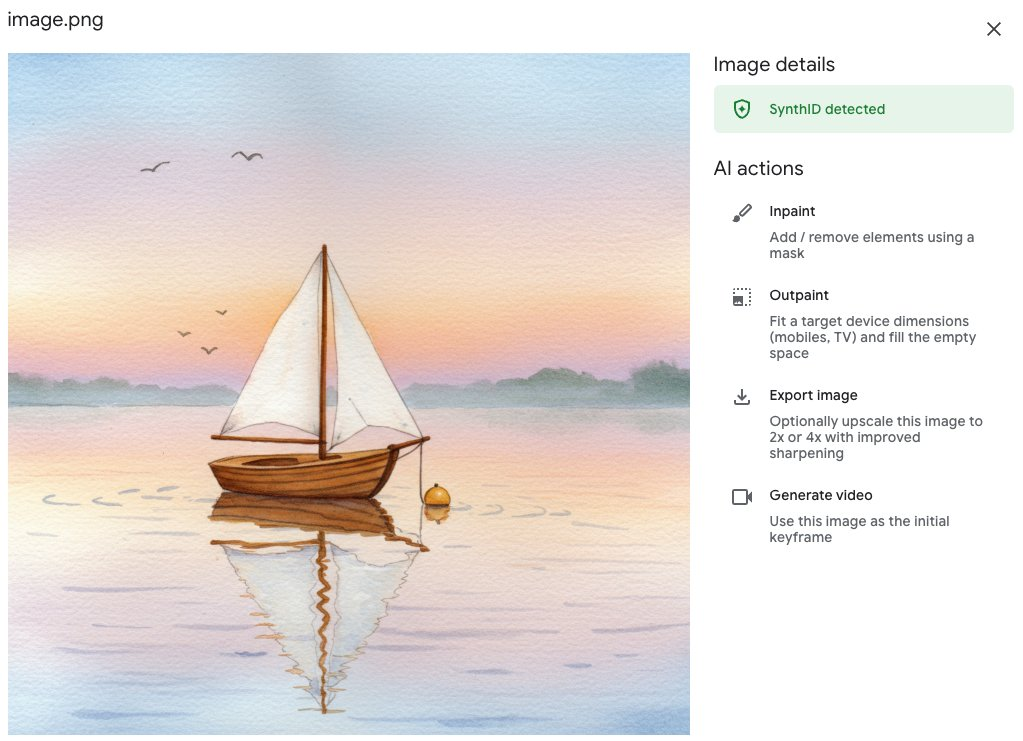
Google can now tell exactly if your content was created by its Gemini AI. It does not use writing style or hidden characters to do it. Instead, the detection happens at the “probability level” through a technology called Google SynthID.
By using a ‘bracket tournament’ to choose words, Google embeds an invisible mathematical signature into every sentence. It can find AI-generated text by biasing the statistical probability of word selection during generation.
With the rollout of the March 2026 Core Update, these watermarks are becoming a primary signal for search quality filters. Google has the massive infrastructure to detect these signatures at scale. They use them in core algorithm updates to reward content that provides ‘Information Gain.’
Additionally, they penalize sites that publish raw, unedited AI drafts. They may potentially trigger a ‘Watermark Panda’ event for low-effort websites.
3 Key Takeaways
- Statistical Fingerprinting: SynthID doesn’t change what a reader sees. It subtly adjusts the probability of which words the AI chooses. This creates a pattern detectable only by math.
- Infrastructure at Scale: Google is backed by record-breaking infrastructure deals. These include a $300 billion commitment to data centers. Google now has the compute power to scan the web for these invisible watermarks.
- The “Watermark Panda”: The March 2026 Core Update uses these signals to differentiate content. “AI-assisted” content is high quality. “AI-replaced” content is low effort. It rewards pages that add unique human value.
What Is Google SynthID?
Google SynthID is a watermarking system built by Google DeepMind to tag and identify AI-generated content. It works invisibly across text, images, audio, and video — without changing the quality of the content itself.
SynthID was first launched for AI-generated images. Google has since expanded it to cover all major content types. These are produced by its AI models. As of 2025, over 10 billion pieces of content have already been watermarked with SynthID. These include images created with Imagen, audio from Lyria, videos from Veo, and text generated by the Gemini app.
Think of it like a watermark on a banknote. You can’t see it in normal light, but the right scanner will find it instantly. For AI content, the “scanner” is Google’s own detection infrastructure — and it runs at internet scale.
How SynthID Works: The Token-Level Mechanism Explained
SynthID Text is a logits processor — a mathematical modifier applied during the generation step. To understand why that matters, here is a quick breakdown.
For years, AI detectors attempted to decide if a human wrote a blog post. They did this by analyzing ‘burstiness’ or identifying common AI phrases like ‘In the ever-evolving landscape.’
Google’s Google AI team has moved far beyond that. Their SynthID-Text system watermarks content before the words are even chosen.
Large language models generate text one ‘token’ (word fragment) at a time. For every choice, the model looks at the surrounding context and a ‘secret key’ to bias the selection. Google calls this a ‘bracket tournament‘.

When Gemini generates the sentence “My favourite tropical fruits are mango and…”, it calculates the likelihood of every possible next word. “Bananas” might score 0.72. “Pineapple” might score 0.65. “Airplanes” might score 0.001. Normally, the model picks probabilistically from the top options.
SynthID applies a pseudorandom g-function. It is seeded with a secret key. This function quietly adjusts those scores before the word is picked. Some words get a slight boost. Others get a slight penalty. The changes are too small for any individual word choice to look odd. But across hundreds of tokens, a detectable statistical signature accumulates.
According to Google’s official developer documentation, the watermarking configuration uses two key parameters:
- Keys: A list of unique random integers used to compute scores across the model’s vocabulary. More keys mean more layers of watermarking.
- Ngram length: Controls how much context the watermark uses. A length of 5 is the recommended default — long enough to be detectable, short enough to stay robust.
No additional AI training is needed to apply or detect this watermark. It plugs into the generation pipeline and runs automatically.
In simple words , imagine ten possible words the AI could use next. The system puts them into pairs and runs a ‘matchup’ based on a secret mathematical rule. The winners of these matchups move on until only one word remains. This process makes sure the final text sounds natural to humans. It also holds a statistical pattern that Google’s detectors can verify with near-perfect accuracy.
No stylistic fingerprint. No metadata. Invisible to readers, detectable by math.
This approach is different from C2PA metadata, which is often stripped when content is copied into a new editor. Because the watermark is woven into the choice of words, it survives basic copy-pasting. Researchers have found that “heavy editing” can degrade the signal. Generating in very short bursts (under 200 tokens) also affects the signal. The math requires a certain length of text to become statistically significant.
Does Gemini Use SynthID? How does it work?
Yes. Gemini applies SynthID text watermarking by default to content it generates. This applies to the Gemini app, the Gemini web experience, and AI outputs generated through Google’s Vertex AI platform.
The watermark is not added after the text is written. It is baked into the process of writing it — during generation itself.
Here is how it works:
Large language models like Gemini generate text one token at a time. A token is roughly a word or word-fragment. For each token, the model assigns probability scores to thousands of possible next words. Normally, the model picks from the highest-scoring options. SynthID subtly adjusts those probability scores. It uses a secret key and the surrounding context. This adjustment nudges certain words into being chosen more often than they otherwise would be.
The result is a statistically detectable pattern, spread across the full output. There is no stylistic fingerprint. No metadata tag. Nothing a human reader would notice. You need to run the right Bayesian detector against the text. The same kind is available through Hugging Face Transformers. Then the watermark shows up clearly.
As discussed, Google itself describes the approach as a “bracket tournament” for token selection. Each word choice goes through a biased competition. The secret key quietly tips the odds in this competition.
SynthID Text vs. SynthID for Images: What’s Different?

SynthID for images and SynthID for text work on different principles, but both embed watermarks that survive common modifications.
For images, SynthID adds an invisible pixel-level pattern that survives cropping, compression, and filter effects. The arXiv paper on SynthID-Image documents that the system has watermarked over ten billion images. It has also watermarked video frames across Google’s services. A verification service is available to trusted testers.
For text, the watermark is statistical rather than pixel-based — distributed across the probability choices in the generation process. This makes it harder to strip out, because there is nothing in any single word to remove.
The practical difference for content creators: defeating the image watermark requires tools that directly manipulate pixel data. To defeat the text watermark, one needs to understand the statistical patterns in the token distribution. Disrupting these patterns presents a far more technical challenge.
That said, the text watermark does have known weaknesses. Google’s own documentation is transparent about this:
- Thorough rewriting significantly reduces detector confidence.
- Translation to another language degrades the signal.
- Factual responses are harder to watermark, because there are fewer word choices to adjust without hurting accuracy.
How to Detect AI Content Using SynthID
Google has launched the SynthID Detector, a verification portal that scans uploaded content for SynthID watermarks. It supports images, audio, video, and text in one interface.
As announced by Google DeepMind, the portal works in three steps:
- Upload an image, audio track, video, or piece of text.
- The system scans for a SynthID watermark.
- Results show whether the watermark is present. They also show which specific parts of the content are most likely to carry it.
At the moment, access is restricted to journalists, media professionals, and researchers on a waitlist. Broader public rollout has not yet been announced.
You can join the early tester waitlist here.
For developers who want to verify AI content programmatically, a Bayesian detector is available through Hugging Face Transformers v4.46.0+ and on GitHub. The detector outputs one of three states: watermarked, not watermarked, or uncertain. False positive and false negative thresholds are configurable.
Google SynthID API and GitHub: What Developers Need to Know
SynthID Text has been open-sourced, which means any developer can now add this watermarking layer to their own AI models. This is a significant move — it means watermarked content is not limited to Google’s own products.
The SynthID Text implementation on GitHub offers a reference codebase. It aids open-source maintainers who want to bring this technique to other frameworks. A production-grade version ships with Hugging Face Transformers.
Google has announced a partnership with NVIDIA. This partnership involves watermarking videos generated through NVIDIA Cosmos™. They also partnered with GetReal Security for content verification. The SynthID ecosystem is growing beyond Google’s own tools. More content across the web is now being watermarked. This applies not just to content Gemini creates.
For SEO professionals and content teams, the immediate implication is this: SynthID is not staying inside Google’s walled garden. It is expanding into a broader content provenance infrastructure.
Can You Remove the SynthID Watermark?
No reliable, broadly accessible SynthID remover exists for text — but degrading the watermark signal is possible through heavy editing.
Here is what reduces the signal, according to the research and Google’s own documentation:
- Heavy, substantive rewriting — not light editing. Changing a few words or sentences does not strip the pattern. Rewriting entire paragraphs from scratch, in your own phrasing, degrades the signal significantly.
- Generating in short bursts under roughly 200 tokens — the watermark needs adequate output length. This is necessary to build a statistically detectable pattern. Very short generations don’t carry a strong enough signal.
- Running Gemini output through a different LLM like GPT-4. Mixing token distributions from two different models creates noise. Each model likely carries its own statistical patterns. This noise partially obfuscates the watermark.
There are open-source experiments from the developer community attempting to tackle SynthID for images (see discussion on r/comfyui). Text is more challenging. The watermark has no discrete artifact to target. It is woven into statistical tendencies distributed across the entire piece.
The more important point: the vast majority of people publishing AI content are doing none of the above. They are generating, lightly tweaking, and publishing. For that workflow, the SynthID signal remains largely intact.
SynthID and the Google March 2026 Core Update: What’s the Risk for AI SEO?
Google rolled out its first core update of 2026 in March. It doesn’t specifically name SynthID signals, but the trajectory is clear. Search Engine Land reported that the March 2026 core update is a regular update. It aims to surface relevant and satisfying content. The guidance points firmly toward human-first content strategies.
The biggest shift in this update is the use of “Information Gain” as a primary ranking signal. Google is now explicitly checking if a page contributes something new to the web or simply repeats what already exists.
Google’s guidance remains consistent: write helpful content for people, not for search engines. Sites hit by core updates are advised to ask whether their content is genuinely useful, trustworthy, and created with expertise.
The ‘Watermark Panda’ fears
Here is the strategic concern SynthID introduces for AI SEO practitioners:
Google has the infrastructure to detect its own watermarked content at search scale. It has not confirmed whether SynthID signals feed into the ranking algorithm today. The gap between “AI content is working great for me right now” and “AI content works great forever” may be smaller than most content strategies think.
History offers a useful reference: Google’s Panda update in 2011 penalised low-quality, thin content at scale. Sites that had built traffic on volume-over-quality content woke up to massive ranking drops overnight. If a future core update integrates SynthID signals as a quality signal, sites built on minimal-effort AI output face a structurally similar risk.
| Content Type | AI Signature Status | 2026 Core Update Impact |
| Raw AI Output | Strong SynthID Signal | High risk of quality filter suppression. |
| Lightly Tweaked AI | Moderate Signal | Neutral; depends on “Information Gain”. |
| AI + Expert Human | Degraded/Mixed Signal | High performance; rewarded for unique value. |
| Original Human Work | No Signal | Remains the gold standard for E-E-A-T. |
SynthID Limitations: What It Cannot Do
SynthID is not designed to be a complete, foolproof detection system — and Google says so directly.
Documented limitations include:
- Watermarking is less effective on purely factual content, because fewer word-choice variations are available without affecting accuracy.
- A thoroughly rewritten or translated text will show significantly lower detector confidence.
- The system is not built to stop motivated adversaries. It makes misuse harder, not impossible.
- Detection is probabilistic, not binary — the detector returns a confidence score, not a definitive yes/no.
The Reddit community r/GoogleGeminiAI has documented cases of discrepancies in SynthID detection results. This suggests that the system can be inconsistent. The inconsistency may depend on content type and length.
SynthID is best understood as one layer in a broader responsible AI strategy — not a silver bullet.
Action Points — How to Future-Proof Your Content Strategy
If you run a content operation that uses AI generation, these are the concrete steps to take now:
- Audit your AI content workflow. Identify how much of your published content is generated by Gemini or Vertex AI. These outputs are watermarked by default.
- Assess your editing depth. Light editing — tweaking a few phrases — does not remove the SynthID watermark. If SynthID signals become a ranking factor, minimal-effort AI content carries higher risk than deeply edited or human-rewritten content.
- Prioritize Information Gain: Before hitting publish, ask if your article adds a new perspective. Consider whether it provides unique data or personal experience. These are insights that a model like Gemini couldn’t know.
- Degrade the AI Signal: Don’t use raw AI output. Heavy human editing, restructuring sentences, and mixing insights from multiple models (e.g., using Google AI for research and Claude for structural logic) can help break the statistical pattern.
- Use AI for Production, Not Replacement: Treat AI as a junior analyst. Use it to draft. Have an expert with a “Claude Certified Architect” level of understanding verify and expand the content.
- Audit Your Library: Use “AI Visibility Checkers” to find pages on your site. These pages may be overly reliant on unedited synthetic text. Refresh these pages with human expertise.
- Diversify your AI stack if it matters to you. Using multiple LLMs, not just Gemini, increases statistical noise. This reduces the clarity of any single model’s watermark signature.
- Invest in human editorial layers. Subject matter expertise, original examples, and first-person experience are crucial. Genuine editorial judgment is important too. SynthID can’t watermark them out of existence because they’re not in the AI output in the first place.
- Monitor core update impacts. Use the Google Search Status Dashboard to track algorithm changes that may start integrating content provenance signals.
- If you are a developer, explore the SynthID GitHub repo. Check the Hugging Face Space. These resources will help you understand how the detection pipeline works technically.
Do join the SynthID Detector waitlist if you work in media, journalism, or research. Early access lets you verify AI content before it becomes a public-facing issue.
FAQs on SynthID and AI Content Detection
1. Is SynthID visible to human readers?
No. It is an invisible statistical pattern created by word choices, not a visual mark.
2. Does it work on short social media posts?
Detection becomes reliable typically after 200+ tokens (roughly 150 words). Shorter texts are often too “noisy” to confirm a watermark.
3. Can other LLMs like ChatGPT be detected this way?
OpenAI researchers have studied similar techniques. Evidence suggests they may already be quietly watermarking text. This is done to adhere to regulations like the EU AI Act.
4. Will Google penalize me just for using AI?
No. Google penalizes “low effort” content. If your AI content is helpful and unique, it can still rank. The watermark simply helps Google find out if the content is likely “auto-generated spam.”
5. How do I remove the SynthID watermark?
“Heavy editing” is the most effective way. Rewriting sections, changing the order of ideas, and adding original research disrupts the statistical probabilities.
6. Does “back-translation” work to hide the watermark?
Translating text to another language and back to English (back-translation) can degrade the signal. Yet, research into systems like SynGuard shows that hybrid detectors are improving. They are getting better at finding these “meaning-preserved” edits.
7. Is the SynthID Text detector open source?
Google has released a reference implementation of the SynthID-Text detector on GitHub for research purposes. Nonetheless, their production-scale detectors stay private.
8. Why does Google care if I use their AI to make content?
Unchecked AI-to-AI training creates “model collapse,” where models become homogenous. Watermarking allows search engines to filter synthetic data out of future training sets.
9. What is a “bracket tournament” in this context?
This mathematical process involves candidate words “competing” based on their probability. A secret key ensures the final word choice carries part of the watermark.
10. How does the March 2026 Core Update use watermarks?
It uses them as a quality signal to find content that may have been mass-produced without human editorial oversight.
11. Does mixing Gemini and ChatGPT output help?
Yes. Combining tokens from different models creates “obfuscation.” It mixes different statistical signatures. This process makes it harder for a single-source detector to confirm a watermark.[Original Prompt Context]
12. What is “Information Gain”?
It is a metric for how much unique information your page provides compared to what already exists in Google’s index.
13. Can Gemini detect watermarks from images or audio?
Yes. You can upload images or audio to Gemini. You can ask if they were created or altered by Google AI. The system will check for a SynthID mark.
14. Is this the end of ‘Click-based’ SEO?
No. It is the end of ‘one-click’ SEO. The future belongs to those who use AI as a power tool for humans, rather than a replacement for them.
15. Does Google use SynthID in its search ranking algorithm?
Google has not confirmed this. SynthID signals are not publicly identified as a ranking factor. But, Google has the infrastructure to detect its own watermarked content at scale. Future core updates could integrate this ability.
16. What is a logits processor, and why does it matter for SynthID?
A logits processor modifies the raw probability scores output by a language model before a word is selected. SynthID is a logits processor. It intervenes at the moment of word selection. This intervention occurs rather than after the text is written. The watermark is inseparable from the content itself.
17. Will the Google March 2026 core update penalise AI content?
The March 2026 core update does not specifically target AI content. Google’s guidance remains focused on helpfulness and relevance. The direction of travel suggests AI content quality signals could become a future ranking factor. This is merged with SynthID’s expanding infrastructure.
18. How does SynthID affect AI SEO strategies?
If Google incorporates SynthID detection into its ranking systems, low-effort AI content (generated and lightly edited) faces higher risk. AI-assisted content that includes genuine editorial input, original expertise, and human rewriting carries a meaningfully lower watermark signal.
19. What types of content does SynthID cover?
SynthID covers text (Gemini), images (Imagen), audio (Lyria and NotebookLM), and video (Veo). Over 10 billion pieces of content have been watermarked across Google’s services.
20. Can I verify if an image was made with Google AI?
Yes. You can upload an image to the SynthID Detector portal. Alternatively, ask Gemini directly by uploading the image. Then, inquire whether it was created or altered by Google AI.
Learn more on Google AI ecosystem on AppliedAI Tools:
- Use NotebookLM Cinematic Videos To Transform Your Research [Review Round Up]
- Gemini Nano Banana 2 Reviews: Features for Creative Professionals
- Google Always On Memory Agent Ends AI Forgetfulness – Learn How
- How Universal Commerce Protocol (UCP) Enables AI Shopping (Google, Shopify)
- Google Photos AI: 6 Hacks With Gemini and Nano Banana
- NotebookLM Slide Decks: Reddit Reviews + Example Prompts
- Google Maps AI Tools Explained: Unlock 6 New Features Today
- Claim Free Gemini 3 via Jio Promo Offer in India – Free Deep Think + Nano Banana
- Google Releases LangExtract: Explained + Getting Started FAQs Solved
- Google Veo 3: Advanced AI for Filmmaking With Examples
- Google Cloud AI for McDonald’s – Risks and Customer Experience Efficiency
- Gemini 2.5 Pro Preview: Best AI Coding Tool For Developers
- NotebookLM Slide Decks: Reddit Reviews + Example Prompts
- Google NotebookLM – best AI research assistant for notes
- Learn NotebookLM For Beginners – 2025 Guide With FAQs Solved And Real Examples
Twice a month, we share AppliedAI Trends newsletter.
Get SHORT AND ACTIONABLE REPORTS on AI Trends across new AI tools launched and jobs affected due to AI tools. Explore new business opportunities due to AI technology breakthroughs. This includes links to top articles you should not miss.
Subscribe to get AppliedAI Trends newsletter – twice a month, no fluff, only actionable insights on AI trends:
You can access past AppliedAI Trends newsletter here:
This blog post is written using resources of Merrative. We are a publishing talent marketplace that helps you create publications and content libraries.
Get in touch if you would like to create a content library like ours. We specialize in the niche of Applied AI, Technology, Machine Learning, or Data Science.
Leave a Reply