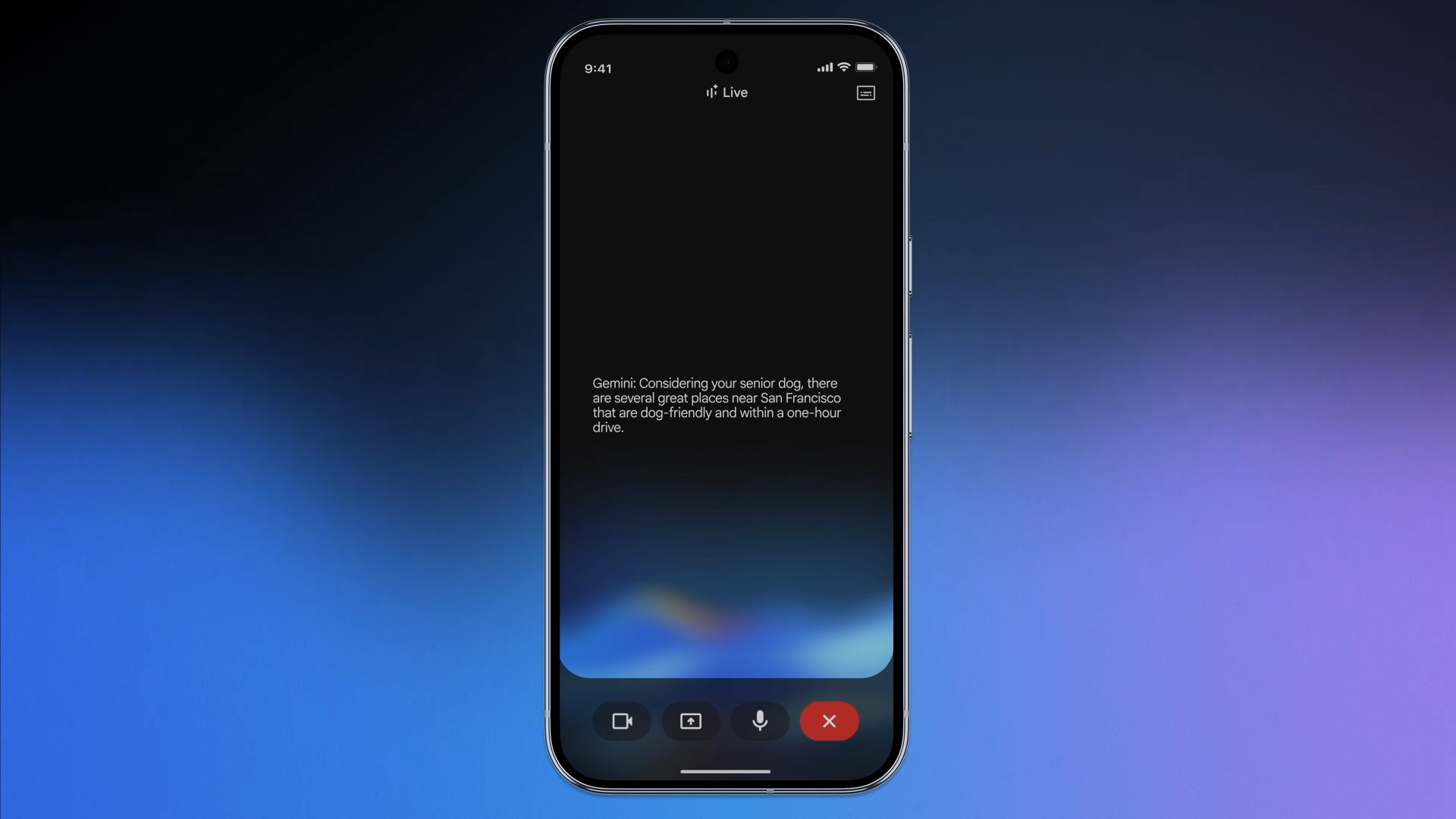
Google’s Gemini 3.1 Flash Live is the most capable real-time voice AI model the company has built. It was released on March 26, 2026. It powers Gemini Live, Search Live, and developer-built voice agents. These tools now have lower latency, smarter noise filtering, and more natural conversation flow. If you have been waiting for AI voice tools to stop sounding robotic, your wait is over. This update closes that gap. It is already live in your Gemini app today.
This is not just a chatbot upgrade. It is a fundamentally different type of AI model, and it is showing up in products you already use.
3 Key Takeaways
- Gemini 3.1 Flash Live is a dedicated audio-to-audio model. It collapses the old transcribe-reason-synthesize pipeline into one real-time process. This cuts the delay between you speaking and the AI responding.
- It is available right now to everyday users via Gemini Live and Search Live. Developers can access it in preview via the Gemini Live API in Google AI Studio.
- Early enterprise and developer feedback confirms real-world improvements in latency and conversation quality over the previous Gemini 2.5 Flash Native Audio model.
What Is Gemini 3.1 Flash Live?
Gemini 3.1 Flash Live is Google’s latest voice-first AI model, purpose-built for real-time, low-latency audio conversations.
To understand why this matters, you need to know how older voice AI models worked.
The process looked like this:
- AI voice model would wait for you to stop talking (Voice Activity Detection)
- Transcribe what you said (Speech-to-Text)
- Pass that text to a language model to think about it
- Synthesize the response back into speech (Text-to-Speech).
By the time the AI spoke, you had already moved on. Each step added delay, and the result often felt like talking to someone with a very slow connection.
Gemini 3.1 Flash Live collapses this entire stack into a single native audio-to-audio process. Think of it like the difference between a game of telephone and a direct phone call. The model does not read a transcript — it processes acoustic nuances like pitch, pace, and tone directly.
Importantly, this is not simply a newer version of standard Gemini Flash. It is a different product category with a different runtime contract, different pricing, and different constraints.
Three cutting-edge audio models launched on the same day across the industry. This is not a coincidence. It reflects a broader race to meet surging demand. Most people talk far faster than they type. Voice dictation tools like Wispr Flow report users working three to four times faster when speaking versus typing. AI companies are racing to meet that appetite.
Explore – Google Gemini 3.1 Flash Live Model Card
Gemini 3.1 Flash Live Performance Review — What the Benchmarks Show
On every major audio benchmark, Gemini 3.1 Flash Live leads its model class.
How Well Does Gemini 3.1 Flash Live Handle Multi-Step Tasks?

The model scores 90.8% on ComplexFuncBench Audio — a benchmark that tests multi-step function calling under real-world constraints. Function calling occurs when an AI does not just answer a question. It also triggers an action. Like, it can book a calendar event, send an email, or pull live data, all during a single voice interaction. A score of 90.8% means it completes these chained tasks with very high reliability.
How Does Gemini 3.1 Flash Live Perform in Noisy, Real-World Conditions?

With “thinking” enabled, the model scores 36.1% on Scale AI’s Audio MultiChallenge. This is a test that deliberately throws interruptions, background noise, hesitations, and distractions at the model. It aims to simulate real-world speech. According to Google’s internal metrics, 3.1 Flash Live is significantly more effective at recognising pitch and pace than the previous 2.5 Flash Native Audio, with notably better performance in noisy real-world environments.
It is worth being honest about the limits here.
These are strong results for a live conversational model. Nonetheless, fully replicating the natural fluidity of unscripted human conversation remains an ongoing challenge. Some non-conversational systems still outperform it on the MultiChallenge benchmark.
At the High thinking setting, Gemini 3.1 Flash Live scores 95.9% on the BigBench Audio Benchmark, second only to Step Audio R1.1 Realtime, with a 2.98-second response time. At the Minimal setting (optimised for speed), quality drops to 70.5% but response time improves to 0.96 seconds — giving developers a meaningful trade-off to tune.
Gemini 3.1 Flash Live vs Previous Gemini Voice Models — What Actually Changed?
Gemini 3.1 Flash Live is a meaningful upgrade from 2.5 Flash Native Audio, but it is not a simple drop-in replacement. Key capabilities improved; a few were changed or not yet carried forward.
What Got Better
| Feature | Gemini 2.5 Flash Native Audio | Gemini 3.1 Flash Live |
|---|---|---|
| Output token limit | 8,192 | 65,536 |
| Conversation thread length | Baseline | 2× longer |
| Noise filtering | Moderate | Significantly improved |
| Tonal understanding | Standard | Enhanced pitch & pace |
| Languages supported | Limited | 90+ |
| ComplexFuncBench Audio | Lower | 90.8% |
| SynthID watermarking | No | Yes (built-in) |
| Thinking control | thinkingBudget | thinkingLevel (minimal–high) |
Gemini 3.1 models use thinkingLevel to control thinking depth, with settings like minimal, low, medium, and high. The default is minimal to optimise for lowest latency. Developers can adjust how hard the model “thinks” before speaking. This adjustment serves as a meaningful lever for voice products where speed and accuracy are in tension.
What Was Removed or Not Yet Carried Over
Google improved the voice quality, latency posture, and operational ceiling. Yet, it also changed the thinking config, server event shape, incremental input model, and tool-use behaviour.
Three 2.5-era capabilities have not been brought forward:
- Asynchronous (non-blocking) function calling
- Proactive Audio (where the model only responds when directly addressed)
- Affective Dialog (emotional tone awareness).
Gemini Live API native audio provided richer and more natural voice interactions. It features 30 HD voices in 24 languages with Proactive Audio enabled. If your current product depends on any of these, treat migration as a real application rebuild. It’s not merely a version bump.
Gemini 3.1 Flash Live vs Other Voice AI Models — How Does It Stack Up?
Gemini 3.1 Flash Live leads on ecosystem integration and tool-use reliability. Competitors hold edges in raw conversational fluidity and some language-specific markets.
Gemini 3.1 Flash Live vs OpenAI Advanced Voice Mode
OpenAI’s Advanced Voice Mode remains the benchmark for raw conversational fluidity, with sub-320-millisecond response times and highly customisable intonation.
Where Gemini 3.1 Flash Live pulls ahead is ecosystem integration. It has native access to Google Search, the world’s largest search index. This is merged with a global visual search feature. No competitor currently matches this at scale. The ComplexFuncBench Audio score of 90.8% also suggests stronger reliability for multi-step voice tasks.
What Independent Benchmarks Show
Scale AI’s Voice Showdown is the first real-world human preference benchmark for voice AI. It launched in March 2026. This event tested 52 model-voice pairs across 11 frontier models. Speech-to-Speech rankings show a tighter race at the top, with Gemini 2.5 Flash Audio and GPT-4o Audio statistically tied at number one in the baseline rankings. After adjusting for response length and formatting, GPT-4o Audio pulls ahead.
Note: this benchmark used Gemini 2.5 Flash Audio — 3.1 Flash Live launched the same week and is not yet included. Updated results are expected.
Language performance also varies by market: GPT-4o Audio leads in Arabic and Turkish; Gemini 2.5 Flash Audio is strongest in French; Grok Voice is competitive in Japanese and Portuguese. VentureBeat
Quick Comparison – Gemini 3.1 Flash Live vs OpenAI Advanced Voice Mode vs Grok Voice vs Apple Siri
| Model | Best For | Key Edge | Tool Use |
|---|---|---|---|
| Gemini 3.1 Flash Live | Voice agents, Search Live | Google Search + Lens | 90.8% ComplexFuncBench |
| OpenAI Advanced Voice Mode | Raw conversational fluidity | ChatGPT ecosystem | Strong |
| Grok Voice | Japanese, Portuguese markets | xAI/X ecosystem | Limited data |
| Apple Siri (Gemini-powered) | On-device, privacy-first | Apple ecosystem | Dependent on Gemini |
What Real Users and Developers Are Saying – Gemini 3.1 Flash Live Reviews
Early feedback spans Android reviewers, production developers, and the broader tech community. The verdict is broadly positive — with a few honest caveats on edge-case behaviour.
Gemini 3.1 Flash Live Review 1 — Android Authority (consumer tech reviewer):
“3.1 Flash Live purportedly makes for a less miserable experience when interacting with an AI customer service agent.” — Android Authority
In Gemini Live on Android and iOS, 3.1 Flash Live delivers faster responses. It has fewer awkward pauses. It can follow the thread of your conversation for twice as long. For everyday Android users, the most noticeable change is simply that conversations flow.
Gemini 3.1 Flash Live Review 2 — Joe Hu, developer at joespeaking.com (Google AI Developers Forum, March 29, 2026):
“We migrated our product from Gemini 2.5 to 3.1 Flash Live and are shipping to production. The conversation quality is noticeably better than 2.5. Latency is lower, responses feel more natural, and we haven’t experienced the 1011 ‘Resource exhausted’ disconnections that occasionally occurred on 2.5. We’re very happy with the upgrade overall.” — Google AI Developers Forum
Joe also flagged two honest edge cases. Occasional turn-taking stalls occur after brief background noise bursts. Non-deterministic function calling happens after long conversation sessions. Both were handled with client-side fallbacks. This is the kind of real-world nuance that benchmark scores do not capture.
Gemini 3.1 Flash Live Review 3 — r/B2BSaaS community (Reddit, March 2026):
The cost drop is real, but I think the bigger shift is exactly what you said: routing, memory, compliance, and handoff become the product. Cheap audio is nice, but if the agent can’t pull CRM context or hand off cleanly, it’s still a toy. That’s why stuff like chat data is more interesting to me than raw model pricing. Curious whether you’re seeing teams optimize for latency first or for tool-calling reliability first? — r/B2BSaaS)
The thread focused heavily on enterprise and SaaS implications — particularly customer service automation and voice agent deployment. Early commenters also flagged the free API tier in Google AI Studio as a low-risk entry point for testing.
Gemini 3.1 Flash Live Review 4 — r/Bard community (Reddit, March 2026):
“The previous live model was rather bad, or at least seriously outdated. So this is a welcome improvement. That being said, I really wish they’d released the actual 3.1 Flash instead.” — r/Bard, Reddit
A cautiously positive take from a longtime Gemini Live user. The commenter acknowledges the upgrade is genuine but flags that the bigger community ask — a full 3.1 Flash release — remains unmet.
Gemini 3.1 Flash Live Review 5 — r/Bard community (Reddit, March 2026):
“First impression, extremely better than 2.5 on latency. But apparently that broke everything else, tool calling is even worse than it was on 2.5, only tried minimal thinking, maybe trying other thinking levels would help. I am using it with Egyptian Arabic, dialect handling is worse too.” — r/Bard, Reddit
The user confirms the latency improvement is real. But, they raise two concrete regressions: tool calling reliability and dialect handling, specifically Egyptian Arabic. This agrees with the developer forum finding on non-deterministic function calling. It adds an important multilingual note that the official announcement glosses over.
Gemini 3.1 Flash Live Review 6 — r/Bard community (Reddit, March 2026):
“Great, the tts is better and it seems smarter. But the same stupid problems are still there, after a few turns it says that there were something wrong with the server, or suddenly the tts stops and regenerate and again and again … Google is unable to fix any bug, that’s well known.” — r/Bard, Reddit
The user agrees the TTS quality and intelligence are genuinely better. Yet, the user is frustrated that persistent session stability issues from previous versions haven’t been fixed. The specific bugs mentioned include server errors mid-conversation. They also cover TTS regeneration loops. These issues echo what Joe Hu documented in the developer forum (the 1011 “Resource exhausted” disconnections).
What Are the Best Use Cases for Gemini 3.1 Flash Live?
Gemini 3.1 Flash Live is built for any product where voice is the primary interface — not a convenience add-on.
Building Voice Agents and Conversational Agents
A voice agent executes tasks by voice command — booking, searching, triggering tools. A conversational agent holds a sustained back-and-forth dialogue. Gemini 3.1 Flash Live is designed to support both capabilities. It is particularly strong when those two overlap. Think of a customer service bot that answers questions and processes a return in the same call.
Real-world enterprise adopters already include Verizon, The Home Depot, and LiveKit. They all gave positive feedback to Google. The feedback was on improved natural conversation flow. If you need a voice agent with turn-taking speech interaction and low-latency audio output, consider Gemini-3. It’s perfect for the Live API session model. gemini-3.1-flash-live-preview is the right choice.
“If voice is the product, choose it early and design around its constraints.” — LaoZhang AI Blog
Everyday Consumer Use Case — Gemini Live and Search Live
Search Live is now available in more than 200 countries and 90+ languages, all powered by Gemini 3.1 Flash Live. Users can point their phone camera at something. They can ask a question in their native language. They can also hold a real-time back-and-forth conversation. And this happens all in a single session.
Consider what this unlocks. You can read a restaurant menu in a foreign country. Get live troubleshooting help for a broken appliance. Brainstorm a project out loud for 20 minutes without the AI losing the thread.
Most people talk three to four times faster than they type. Gemini 3.1 Flash Live is built to keep up.
Developer Use Case — Building Voice-First Apps
For developers, the real shift occurs within the Multimodal Live API. It is a stateful, bi-directional streaming interface. The interface uses WebSockets to keep a persistent connection between the client and the model.
Think of it like a phone call that stays open rather than a series of text messages sent back and forth. This is what enables interruption handling and long multi-turn sessions.
Real apps already in production include Stitch. It offers voice-enabled design collaboration. Another app is Ato, which serves as an AI companion for older adults. Weekend’s Wit’s End RPG is also in production. In this game, the model acts as a Game Master with theatrical voice delivery.
How to Get Started with Gemini 3.1 Flash Live
You can start using Gemini 3.1 Flash Live today — no developer account required for the consumer version.
For everyday users: Open the Gemini app and use Gemini Live — 3.1 Flash Live already powers it. Open Google Search and use Search Live — now available in 200+ countries.
For developers: Go to ai.studio/live. Use model string gemini-3.1-flash-live-preview via the Gemini Live API. A free tier is available for testing before you scale. One critical constraint to know upfront: the model currently uses sequential tool calling only — no async/non-blocking function calls yet. If migrating from 2.5, audit your async function calling, Proactive Audio, and Affective Dialog dependencies before switching.
For enterprises: Access via Gemini Enterprise for Customer Experience on Google Cloud. Test via the free AI Studio tier before committing to enterprise pricing.
Action Points — How to Use This Information
- Consumer: Update your Gemini app. Try Gemini Live for longer, hands-free brainstorming or real-time search in your language.
- Developer (new build): Start on
gemini-3.1-flash-live-preview— it is the correct default for voice-first builds today. - Developer (migrating from 2.5): Audit your async function calling, Proactive Audio, and Affective Dialog dependencies before switching. Do not treat it as a version bump.
- Enterprise: Test via the free AI Studio tier before committing to Gemini Enterprise pricing.
- Stay updated: Follow @GoogleDeepMind and @demishassabis on X for real-time model updates.
FAQs on Gemini 3.1 Flash Live
1. What is Gemini 3.1 Flash Live?
Gemini 3.1 Flash Live is Google’s highest-quality real-time audio and voice AI model, released March 26, 2026. It processes audio natively — without converting speech to text first — enabling faster, more natural conversations.
2. How is Gemini 3.1 Flash Live different from Gemini Live?
Gemini Live is the product (the app interface). Gemini 3.1 Flash Live is the AI model that powers it. Think of Gemini Live as the car and 3.1 Flash Live as the engine upgrade under the hood.
3. What is the Gemini 3.1 Flash Live performance on benchmarks?
It scores 90.8% on ComplexFuncBench Audio and 36.1% on Scale AI’s Audio MultiChallenge with thinking enabled. At the High thinking setting, it scores 95.9% on BigBench Audio — second only to Step Audio R1.1 Realtime.
4. Is Gemini 3.1 Flash Live available on Android?
Yes. It powers Gemini Live on both Android and iOS. This delivers faster responses with fewer pauses. It also provides the ability to hold a conversation thread twice as long as the earlier model.
5. What are the best use cases for voice agents built on Gemini 3.1 Flash Live?
Customer service automation, real-time sales support, accessibility tools, live translation, voice-controlled design tools, and AI companions. Any use case where users interact primarily by speaking rather than typing.
6. How do I access the Gemini 3.1 Flash Live API?
Go to ai.studio/live. Use model string gemini-3.1-flash-live-preview via the Gemini Live API. A free tier is available for testing.
7. What is a conversational agent and how does Gemini 3.1 Flash Live power one?
A conversational agent holds sustained, natural back-and-forth dialogue — not just answering one question at a time. Gemini 3.1 Flash Live makes this possible. It processes audio natively. It maintains a persistent WebSocket connection. It keeps conversation context for twice as long as its predecessor.
8. How does Gemini 3.1 Flash Live handle background noise?
It filters out background noise — traffic, television, chatter — more effectively than Gemini 2.5 Flash Native Audio. In tests, it maintained 85% speech recognition accuracy in challenging acoustic conditions.
9. Is Gemini 3.1 Flash Live free to use?
For consumers, yes — it is built into the free Gemini app and Search Live. For developers, a free tier is available in Google AI Studio. Enterprise access via Google Cloud is paid.
10. What companies are already using Gemini 3.1 Flash Live?
Verizon, The Home Depot, and LiveKit gave positive early feedback cited by Google. Developer apps including Stitch, Ato, and Weekend’s Wit’s End RPG are already using it in production.
Learn more on Google AI ecosystem on AppliedAI Tools:
- Gemini Nano Banana 2 Reviews: Features for Creative Professionals
- Google Always On Memory Agent Ends AI Forgetfulness – Learn How
- How Universal Commerce Protocol (UCP) Enables AI Shopping (Google, Shopify)
- Google Photos AI: 6 Hacks With Gemini and Nano Banana
- NotebookLM Slide Decks: Reddit Reviews + Example Prompts
- Google Maps AI Tools Explained: Unlock 6 New Features Today
- Claim Free Gemini 3 via Jio Promo Offer in India – Free Deep Think + Nano Banana
- Google Releases LangExtract: Explained + Getting Started FAQs Solved
- Google Veo 3: Advanced AI for Filmmaking With Examples
- Google Cloud AI for McDonald’s – Risks and Customer Experience Efficiency
- Gemini 2.5 Pro Preview: Best AI Coding Tool For Developers
- NotebookLM Slide Decks: Reddit Reviews + Example Prompts
- Google NotebookLM – best AI research assistant for notes
- Learn NotebookLM For Beginners – 2025 Guide With FAQs Solved And Real Examples
Twice a month, we share AppliedAI Trends newsletter.
Get SHORT AND ACTIONABLE REPORTS on AI Trends across new AI tools launched and jobs affected due to AI tools. Explore new business opportunities due to AI technology breakthroughs. This includes links to top articles you should not miss.
Subscribe to get AppliedAI Trends newsletter – twice a month, no fluff, only actionable insights on AI trends:
You can access past AppliedAI Trends newsletter here:
This blog post is written using resources of Merrative. We are a publishing talent marketplace that helps you create publications and content libraries.
Get in touch if you would like to create a content library like ours. We specialize in the niche of Applied AI, Technology, Machine Learning, or Data Science.
Leave a Reply