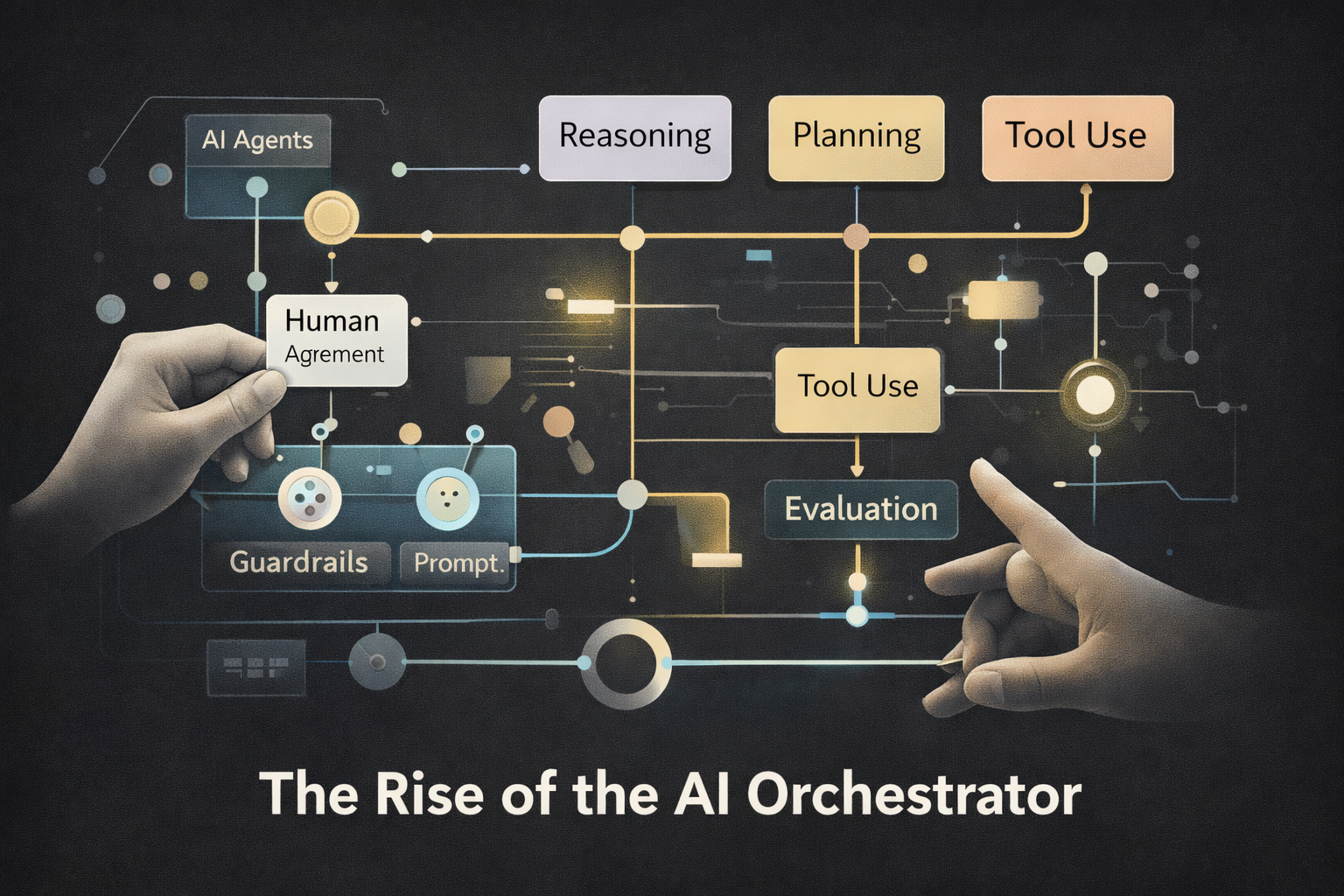
Our first issue of Applied AI Trends Newsletter explores rise of AI Orchestrator jobs due to industry-wide AI adoption.
Twice a month, get short, actionable reports on the latest AI trends. Discover AI tools stack replacing legacy skills, shifting job roles, and emerging business opportunities. Subscribe now to stay ahead of what AI is changing next.
Here’s a TL;DR for this report:
- The Problem: Operator roles are optimized for execution. They are fading as AI reduces the cost of ‘doing’ tasks to near zero.
- The Solution: Transition to Orchestration. Move from performing tasks to designing systems that coordinate AI agents.
- Key Roles: AI Workflow Orchestrator, AI Operations Manager, AI Product Strategist, AI Content Orchestrator, and AI Systems Designer.
- The Skills: Systems thinking, Prompt Architecture, Output Evaluation (XAI), and Knowledge Provenance.
- The Payoff: AI-enhanced roles command 60−150% salary premiums, with many mid-career orchestrators earning over $150,000.
- Final Insight: In the AI-first workplace, the most valuable worker is the ‘Decision Designer,’ not the ‘Task Executor.’ Orchestrators win by owning outcomes, not hours.
AI didn’t remove work. It changed where human judgment sits.
Agentic AI systems are learning to reason, plan, and use tools independently. As a result, the economic advantage of human-led execution is rapidly eroding.
In 2026, the unit cost of a decision made by an AI agent is significantly lower than a human operator. This has lead companies to focus on automation for high-volume, low-risk tasks. This does not imply that the work itself has disappeared; rather, the ‘Human-in-the-Loop’ (HITL) model has shifted.
Humans no longer do the middle steps of a process. Instead, they define the constraints at the beginning and evaluate the outcomes at the end.
What’s going on with traditional operator jobs?
Traditional ‘Operator’ roles are optimized for execution rather than decision-making. As AI commoditizes repetitive workflows, content generation, and basic analysis, the economic value of manual execution is collapsing.
As of 2026, AI has transitioned from a reactive tool to a proactive teammate. Thus, the human value moves from the ‘doing’ of work to the design and management of intelligent systems.
What do you mean by ‘AI Orchestration’?
To understand orchestration, one must look at the four capabilities that agentic AI adds to static automation :
- Reasoning: The ability to interpret natural language instructions and system logs to decide the next best action.
- Planning: The capacity to break a complex goal (e.g., “optimize this supply chain”) into a sequence of executable steps.
- Tool Usage: The ability to call APIs, interact with databases, and execute code to bridge the gap between thought and action.
- Self-Evaluation: The iterative process of checking its own output for errors and correcting them before final delivery.
What are ‘AI Orchestrator’ job roles?
Today’s ‘Operators’ need to transition to ‘Orchestration.’
Professionals move from performing individual tasks to designing and managing systems that coordinate AI agents, human judgment, and software tools.
Thus, AI-first job roles now focus on decision ownership, systems thinking, and autonomous workflow coordination.
Unlike traditional automation, which follows ‘if-then’ logic, orchestration uses the reasoning and planning capabilities of Agentic AI. It is the difference between a static assembly line and a dynamic automation engine. This engine learns and adapts to unstructured data and ambiguous instructions.
What is the primary role of AI Orchestrator?
The Orchestrator’s primary role is ‘Decision Design’.
As an AI Orchestrator, you define business goals, mapping workflows, and identifying the constraints within which AI agents must work. This involves moving work ‘earlier’ in the lifecycle (setting constraints) and ‘later’ in the lifecycle (reviewing outcomes). Thus, you effectively hollow out the ‘middle’ where manual execution once sat.
Orchestration platforms, like n8n, LangChain, and Microsoft AutoGen, aid this process. They allow humans to chain together disparate AI models into dynamic workflows.
Difference between Operator and AI Orchestrator
| Feature | The Operator (Legacy) | The Orchestrator (Emerging) |
| Primary Focus | Execution of predefined steps | Design and oversight of systems |
| Core Value | Manual speed and accuracy | Strategic judgment and system reliability |
| Tool Usage | Operates individual software tools | Chains and coordinates multiple AI agents |
| Responsibility | Owns the completion of a task | Owns the quality of the outcome |
| Success Metric | Time spent / Output volume | Output quality / Cost per outcome |
| Decision Style | Deterministic / Rule-based | Probabilistic / Adaptive |
What’s the proof that AI Orchestrator is a thing?
1. Use of AI for information retrieval
According to Gartner, by 2026 traditional search engine volume will drop by about 25%. This happens as AI chatbots and virtual agents replace a segment of queries that earlier went through Google‑style search. Surveys show that roughly a third of consumers who use AI chatbots now turn to them instead of search engines when they have questions.
This shift leads to a change in tasks. Operators used to gather information, synthesize it, and route it. Now, autonomous layers of the internet infrastructure carry out these tasks.
2. Rise of Model Context Protocols
The rapid adoption of the Model Context Protocol (MCP) acts as a ‘USB-C moment’ for the AI industry.
MCP provides a standardized way for AI agents to access context, tools, and remote infrastructure. It allows for a decentralized layer of security and user memory. This standardized approach to orchestration means that companies now need specialists who can manage these protocols. It leads to job titles like ‘AI Workflow Orchestrator’ and ‘AI Systems Designer’.
3. The AI Orchestrator specific job roles are out there already
Demand for AI-native roles has reached a fever pitch. In the first half of 2025, AI-related job postings in the United States grew by over 25% compared to the earlier year.
According to Autodesk’s AI Job Report, the growth rates for specific orchestration-focused titles are staggering:
- AI Engineer: +143.2%.
- AI Content Creator: +134.5%.
- AI Solutions Architect: +109.3%.
- AI Systems Designer: +92.6%.
This data suggests that fluency in AI is no longer a niche technical skill. It has become a baseline need for career longevity across all ‘Design and Make’ industries. Companies are moving away from labor-heavy models toward growth systems that reduce cost and increase speed through intelligent orchestration.
| Market Trend | 2023 | 2024 | 2025 (YTD) |
| AI Job Listing Growth | +114.8% | +120.6% | +56.1% |
| AI Related Job Postings (US) | 25,000 | 28,000 | 35,445 |
| Median Salary for AI Roles | $132,000 | $145,000 | $156,998 |
AI Orchestrator job roles landscape in the market
I have shared some typical AI orchestrator roles I found online using secondary research:
AI Workflow Orchestrator:
- AI Workflow Orchestrator Job Role: Designs end-to-end automated sequences for sales, HR, and ops. They must make sure that AI models are triggered correctly and their outputs are processed reliably.
- Core Tech Stack: n8n, Zapier, Make.com, LangGraph, and various MCP servers.
- Strategic Focus: Bridging human intent with autonomous, adaptive execution.
- Key Success Metric: Reduction in cycle time and ROI per automated workflow.
- Salary: $120,000 – $180,000 (typical for “Success Architect” roles).
AI Orchestrator Job Example:
At Boam AI in Toronto, the Workflow Orchestrator is expected to creates automations that integrate multiple APIs. Their purpose is to remove manual data entry.

Content Engineer:
- Content Engineer Job Role: Manages multi-model ecosystems to scale brand-consistent content. They do not write; they architect ‘Modular Content System Design’. This involves creating blocks of structured data that AI systems (like ChatGPT or Google AI Overviews) can easily interpret and cite. They focus on ‘Citation Optimization,’ ensuring their organization’s content is the primary source referenced by AI-generated answers.
- Core Tech Stack: Migma, Jasper, AirOps, Copy.ai, and Hostinger SEO Checker MCP.
- Strategic Focus: Maximizing brand visibility and citation rates in AI-mediated search environments.
- Key Success Metric: Citation frequency in AI-generated answers (e.g., Google AI Overviews).
- Salary: Salaries range from $85,000 to $125,000, a 70% – 150% increase over traditional content writing roles.
Content Engineer Job Example:
Ramp expects its Content Engineer to use Agentic AI tools to design full content production workflows.

AI Operations (AI Ops) Manager:
- AI Operations Job Role: Oversees the day-to-day operation of multiple AI agents. It monitors model drift, manages prompt logging, and executes incident response for hallucinations. They also handle the financial dimension of AI, optimizing for the highest quality of output per dollar spent.
- Core Tech Stack: Kubernetes, cloud infrastructure (AWS/Azure), and specialized AI monitoring dashboards.
- Strategic Focus: Ensuring the reliability, safety, and operational health of deployed AI systems.
- Key Success Metric: Output reliability % and Operational cost per inference.
- Salary: $130,000 – $145,000 (median range).
AI Operations Manager Job Example
Marvell Technology, an semiconductor manufacturing firm, hires AI Ops Managers to oversee agentic workflows. This particular job is at management level, demanding engineering team management and fundamental AI-first strategy implementation.

AI Product Strategist:
- AI Product Strategist Job Role: Decides where AI creates value and how it should be ethically integrated into the user experience. They define product requirements for AI capabilities like RAG and semantic search. Authors governance frameworks. Acts as the bridge between Engineering and Legal.
- Core Tech Stack: Azure OpenAI, Claude, LangChain, and various product roadmapping tools.
- Strategic Focus: Aligning technical AI feasibility with long-term business value and ethical standards.
- Key Success Metric: AI-native feature adoption rate and regulatory compliance score.
- Salary: $120,000 – $220,000
AI Product Strategist Job Example:
Wiley, a USA based Book and Periodical Publishing company, recently shared an opening for AI Product Strategist to develop new enterprise AI products. If you check its responsibilities, it is of a typical product strategist – but focused on AI technology and workflows. They must lead the full development lifecycle, translating complex technical concepts for non-technical stakeholders like legal and content teams.

AI Systems Designer:
- AI Systems Designer Job Role: Architects the logic for human-AI collaboration, defines handoff and escalation protocols, and oversees cross-platform integrations.
- Core Tech Stack: Adobe Workfront, Firefly, Frame.io, and custom-built MCP connectors.
- Strategic Focus: Empowering human teams through high-leverage, reliable system architecture and data flow governance.
- Key Success Metric: Engineering velocity and reduction in system downtime.
- Salary: $185,000 – $252,000
AI Systems Designer Job Example:
At JPMorgan Chase, the AI Systems Designer integrates tools like Adobe Firefly and Frame.io to empower teams to deliver innovative visual experiences at scale. They are expected to design the ‘data flow’ between automated features and human stakeholders. This ensures that creative assets are delivered on time and with high impact.

AI tools tech stack for AI orchestrator roles
- Visual Automation Engines: Learn and use n8n, Make, or Zapier to connect apps without deep code.
- Agent Frameworks: Deploy collaborative teams using CrewAI, LangGraph, or Microsoft AutoGen.
- Connectivity Protocols: Implement the Model Context Protocol (MCP) to join product signals with AI context.
- Enterprise Governance: Leverage IBM watsonx Orchestrate or Domo for secure, audited workflows.
- Local-First Dev Stacks: Use Windows AI Foundry or GitHub Copilot Chat extensions for privacy-preserving local AI.
How AI Orchestrator job titles map to old roles
The transition to orchestration is rarely a total replacement of staff; it is more often a repositioning of existing expertise. As manual tasks are automated, the center of gravity for these roles moves up the value chain.
| Legacy Role | AI-First Evolution | The Critical Shift |
| Marketing Manager | Content Engineer | Moving from editing copy to managing prompt architectures and modular content graphs. |
| Operations Analyst | AI Workflow Orchestrator | Moving from spreadsheet management to building autonomous agent chains in n8n or Zapier. |
| Product Manager | AI Product Strategist | Moving from feature roadmaps to managing probabilistic model outcomes and AI ethics. |
| SEO Specialist | Search Ecosystem Strategist | Moving from keyword optimization to AI visibility and citation optimization. |
| L&D Specialist | AI Training Agent Manager | Moving from course creation to managing agentic systems that proactively close skill gaps. |
| Copywriter | AI Content Curator | Moving from drafting to high-level selection, refinement, and domain-specific fact-checking. |
How Operator professionals can transition into AI Orchestrator Roles?
Here is a list of skills to learn and modifications you can make to existing operator responsibilities to map your transition:
Develop these 4 skills that define AI Orchestrators (Not Operators)
To thrive as an orchestrator, professionals must develop a set of “AI-native” competencies. Manual execution speed is being replaced by the ability to manage complexity and uncertainty.
Systems thinking and workflow mapping
Orchestrators must see the ‘whole board.’ This requires the ability to map messy, human-centered processes into deterministic system flows that an AI can follow. It involves identifying which parts of a workflow are bottlenecks and which are failure points.
Prompt architecture and tool chaining
Mastery of prompt engineering is no longer just about getting a good response from a chatbot. It is about “Prompt Architecture”—building complex, multi-layered instructions that incorporate conditional logic and brand DNA. This includes mastering techniques like “Chain of Thought” (developing thinking step-by-step) and “Few-Shot Learning” (providing examples to the model).
Explainable AI and output evaluation
Because AI models are probabilistic rather than deterministic, orchestrators must understand ‘Explainable AI’ principles. They need to trace the reasoning process of an agent. This helps make sure it aligns with business objectives and regulatory requirements. This step-by-step validation is the primary way human accountability is maintained in an automated system.
Knowledge provenance and data management
Orchestrators must manage the information the AI uses. This is known as “Knowledge Provenance”—documenting which organizational documents or policies informed a specific AI decision. It requires skills in data labeling, bias detection, and ensuring “data quality” over “feature quantity”.
How to get started with transitioning to AI Orchestrator job role?
- Inventory Your Workflows: Document current processes to find bottlenecks and failure points.
- Codify Brand DNA: Translate domain expertise (tone, policy) into AI-readable prompt parameters.
- Master Prompt Architecture: Build multi-layered prompts with conditional logic and few-shot learning.
- Execute a 90-Day Pivot: Transition from tactical production to strategic systems architecture by upskilling in AI tools and systems building.
How to improve your outcomes as AI Orchestrators?
- Focus on ‘Decision Design’: Move work earlier in the lifecycle to set constraints rather than just executing.
- Track Key Performance Metrics: Track Output Quality per Dollar and Decision Latency.
- Audit with Explainable AI (XAI): Use reasoning traces to justify AI-driven actions to stakeholders.
- Build Feedback Loops: Design systems that improve based on real-world outcomes and human-in-the-loop corrections.
Hiring trends: How to get hired as AI Orchestrator?
The job market for orchestrators is distinct from the traditional tech market. Organizations are looking for “Success Architects” who can bridge the gap between AI potential and revenue reality.
Look for industry specific demand
The demand for these roles is particularly high in regulated or high-volume sectors:
- Finance: Seeking AI Ops Managers for fraud detection and compliance orchestration.
- Healthcare: Hiring AI Product Strategists to transform patient data experiences using RAG and agentic workflows.
- SaaS/Tech: Recruiting ‘Go-To-Market (GTM) Engineers’ to build autonomous outbound campaigns.
Find opportunity for AI Orchestrator jobs
Here are some recommendations I could think about that you can explore to enter AI Orchestrator job roles:
Search for ‘Success Architect’ or ‘GTM Engineer’:
Titles like Go-To-Market (GTM) Engineer, Revenue Systems Architect, or Success Architect often mask high-leverage orchestration roles.
Offer an ‘AI Efficiency Audit’ as a Lead Magnet:
Create a productized discovery service ($1,500 – $3,000). This service maps a client’s workflows. It identifies manual failure points and defines specific AI KPIs. This low-friction entry point builds the trust necessary to upsell a full implementation project ($5k – $15k).
Position as a Fractional AI Orchestrator:
Mid-sized businesses are increasingly hiring Fractional Chief AI Officers. They also hire AI Strategists. The goal is to bridge the gap between business goals and technical implementation. Typical mid-tier engagements range from $5,000 to $10,000 per month for 15-25 hours of strategic leadership and implementation oversight.
Target High-Compliance Sectors for Premium Rates:
Specializing in Fintech or Healthcare AI orchestration can command a 25-40% salary premium. This is due to the added complexity of regulatory compliance and data security. These industries specifically need “Decision Designers” who can build human-in-the-loop (HITL) guardrails.
Look for ‘Signal-to-Action’ Missions:
Search job descriptions for ‘missions’ rather than ‘chores’. Target roles are responsible for turning signals like product usage, website forms, or webinar events. They turn these into autonomous actions like lead enrichment, scoring, or instant personalized outreach.
Focus on AI Citation Optimization
As search volume shifts toward AI-mediated discovery, companies are hiring AI Visibility Strategy Directors or Search Ecosystem Strategists. Their primary goal is to make sure their brand is the ‘primary source’ cited in AI-generated answers (e.g., Google AI Overviews).
Pivot from ‘Tactical Production’ to ‘Systems Design’
When applying for roles, emphasize your ability to design the ‘Content Ecosystem’ or ‘Revenue Engine’ rather than individual deliverables. High-value recruiters are looking for Systems Thinkers who can justify premium pay by demonstrating exponential scale through AI amplification.
Companies are hiring for system choreography and context transfer
Companies are moving away from hiring for ‘tool knowledge’ in favor of ‘system choreography’:
Missions over Chores:
Modern job descriptions are evolving. They are moving from detailed task lists, like ‘running reports,’ to broader goals. These goals mainly involve the skill to convert signals into automatic actions, like lead enrichment, fraud alerts, or automated support.
For example, GTM Engineer Jobs is a niche job board for hybrid growth + engineering roles. It curates companies hiring technical AI Orchestrators who can own data, tooling, and automation across revenue teams. A GTM engineer is central here because they build and keep the systems that power modern AI-led go-to-market execution.
You can explore recent job postings to get an idea of the role, requirements, and expectations across hiring companies.

Demand for Context Translators or Prompt Engineers:
Companies are prioritizing candidates who can execute ‘contextual translation.’ This involves teaching AI agents the unwritten rules. It also includes business judgment and brand tone needed to make human-like decisions.
This Prompt Engineer role at Accenture is a great example of an AI prompt / context engineer in a large enterprise setting. The job focuses on designing, testing, and refining prompts and interaction patterns for LLMs to improve response quality and reliability. It also expects you to become an internal SME. You will collaborate with cross‑functional teams. You will analyze model outputs and continually optimize AI behavior using programming and NLP skills.

Architecting Autonomy:
A critical hiring signal is the necessity to design autonomy boundaries. Hiring managers seek professionals who can define exactly which decisions an agent can make alone. They must also recognize where it must pause for human-in-the-loop (HITL) approval.
For example, Automata recently hired for an AI Automation Operations Manager role with a salary of £65,000 – £85,000. This professional works with stakeholders to define Human-in-the-loop requirements, guardrails, and track outputs for robotic and software workflows. They serve as the internal automation product owner. They transform complex processes into reliable AI-enabled workflows. They make sure of governance and adoption across the company.

The Integration Gap Specialist:
Organizations are actively recruiting “AI Agent Orchestration Specialists” to bridge the gap between AI potential and production. Data shows that teams with these specialists achieve full agent productivity 65% faster than those without them “.
For example, First Databank was seen hiring a AI Product Architect Director. The role blends technical architecture with strategic insight. It helps to “guide the next generation of AI-enabled systems.” These systems are scalable, reliable, and safe for healthcare data.

Baseline Competency Shift:
Skills like model monitoring, cost optimization, and governance (MLOps) are no longer differentiators. They are now considered minimum requirements for any orchestration or operations role.
For example, Concord, a USA-based MCP infrastructure company, was seen recently hiring for an AI Operations Manager for business operations. This role specifically requires ‘steady habits for testing, monitoring, and version control.’ These habits are part of the core responsibility of running AI workflows and agents that power go-to-market operations.

We want to interview AI Orchestrators – connect with us if its YOU!
If you are an AI orchestrator or in a related job role, please email us. We would like to feature quotes for our deep dive reports on the changing job landscape.
Email us to content@merrative.com
Subscribe to AppliedAI Trends
Twice a month, we share AppliedAI Trends newsletter.
Get SHORT AND ACTIONABLE REPORTS into upcoming AI Trend across new AI tools launched, jobs impacted due to AI tools, and new business opportunities due to AI technology breakthroughs. This includes links to top articles you should not miss, like this AI report on AI Orchestrators you just read.
Subscribe to get AppliedAI Trends newsletter – twice a month, no fluff, only actionable insights on AI trends:
You can access previous AppliedAI Trends newsletter here:
About Merrative

At Merrative, we aim to build a collective of writers, analysts, scholars, and journalists to create and discuss thought-provoking content.
We aim to create a one-stop place to access human expertise to publish thought leadership content — starting with newsletters.
Applied AI Trends is one of our portfolio newsletters, along with Media First Brand, Founder Leverage, and ReadTreats. Based on your content strategy, we can help you publish below 4 types of newsletter formats:
- Case Studies Newsletter – Breaks down real wins and success stories to show authority.
- Data Stories Newsletter – Turns industry data and trends into clear, actionable insights.
- Industry Expert Interview Newsletter – Extracts frameworks and lessons from expert conversations.
- Content Curation Newsletter – Curates the most important ideas with takeaways and links so readers don’t have to.
Leave a Reply