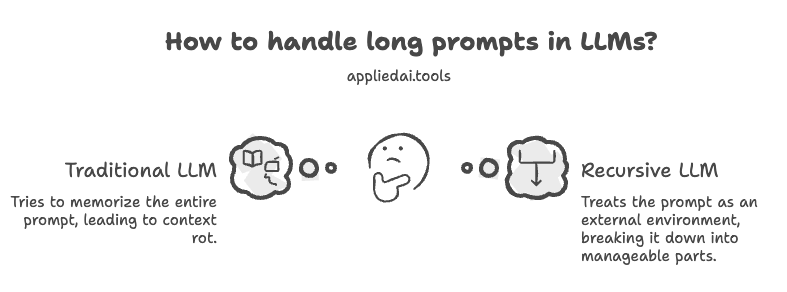
Recursive Language Models (RLMs) allow current AI like GPT-5 to process millions of pages of information. This is done without the AI getting confused or breaking the bank.
Researched by MIT, this marks as the next big leap in AI.
It is not about giving models ‘bigger brains’. It’s about teaching them how to use a library. Instead of trying to memorize a massive document all at once, the AI writes its own computer code. It searches, slices, and delegates tasks to smaller versions of itself.
You can read their published paper here: Recursive Language Models
In this explainer, I will help you understand what is Recursive Language Model (RLM) in simple language without jargons. Learn how its different from current LLMs and how to get started in exploring it for your use case.
3 Key Takeaways:
- Infinite Context: RLMs handle data up to two orders of magnitude larger than current model limits exemplified by models like GPT-5. This capacity reaches the 10 million+ word territory.
- Solves ‘Context Rot’: Traditional AIs lose focus as data grows. RLMs keep their ‘eyes’ on specific snippets at a time, maintaining accuracy regardless of total document size.
- Auditor-Level Precision: Rather than ‘chatting’ through a file, the AI acts as an auditor. It writes code to surgically audit data. It verifies its own findings before reporting.
What are Recursive Language Models (RLMs)?
To understand an RLM, think of how you’d handle a 1,000-page legal contract. You wouldn’t try to memorize every single word in one sitting. Instead, you’d look at the Table of Contents. Then, find the sections about ‘Liability.’ You might ask three different assistants to summarize those specific chapters for you. You then take their summaries and make your final decision.
Current Large Language Models (LLMs) usually try to ‘memorize’ the whole 1,000 pages at once. Recursive Language Models (RLMs) fix this by treating long prompts as an external environment the AI can symbolically interact with. Instead of feeding the whole document into the AI’s ‘brain,’ the RLM:
- Loads Data as a Variable: It treats the document like a file in a computer’s memory (Python REPL).
- Writes Code: It writes Python programs to search for keywords or specific snippets.
- Delegates via Recursion: It calls a ‘sub-version’ of itself to read just those snippets.
- Stitches Results: It combines the findings from these sub-calls into one final, verified answer.
How do Recursive Language Models Solve Context Rot Problem in LLMs?

‘Context Rot’ is the phenomenon where even the world’s most powerful models, like GPT-5, see their performance degrade significantly as the input gets longer. It’s essentially the AI acting like a ‘goldfish’. It skims the middle, misses the footnotes, and loses its reasoning edge as it gets overwhelmed.
Here’s a graph showcasing performance of GPT-5 degrades due to complexity while RLM maintains strong performance:

4 ways RLMs overcome context rot:
- Segmented Reasoning: By breaking a 10-million-token file into ‘smart chunks,’ the AI never has to process too much information at once.
- Programmatic Filtering: Instead of ‘reading’ linearly (which fails), the RLM uses code (like regex queries) to filter information based on reasoning.
- Sub-LM Verification: RLMs use separate, smaller AI calls to verify specific facts in tiny context windows where accuracy is highest.
- Symbolic Interaction: By treating the prompt as a variable rather than raw text, the AI maintains a ‘mental map’ of the data without getting lost in the words.
Why RLMs Matter: From Skimming to Auditing
The difference between a standard prompt and an RLM is the difference between an intern skimming a document and an auditor certifying it. In MIT’s tests, standard GPT-5 performance crashed on complex tasks as the document grew. However, the RLM version maintained strong performance even at massive scales.
Difference between standard LLM and Recursive Language Model:
| Feature | Standard LLM (e.g., GPT-5) | Recursive Language Model (RLM) |
| Max Capacity | Limited by Context Window | Effectively Unbounded |
| Accuracy | Drops as data grows (“Rot”) | Stays high via focused sub-calls |
| Strategy | Statistical Skimming | Surgical Code Auditing |
| Cost | High for long-context calls | Comparable or cheaper |
A Step-by-Step Walkthrough of how Recursive Language Model Works

To make the concept less abstract, here is how a successful run looks, based on MIT’s experiments where GPT-5 searched through 1,000 documents:
- Step 1: The Probe: The AI writes a regex script to ‘scan’ the context for keywords like ‘beauty pageant’ or ‘festival’.
- Step 2: The Deep Dive: It identifies a ‘key chunk’ (e.g., index 6) and launches a recursive sub-LM call to extract specific details.
- Step 3: The Double-Check: It uses extra sub-LM calls to verify the findings—confirming dates and names—before reporting back.
- Step 4: The Stitch: It takes the verified data and formats the final answer (e.g., ‘Maria Dalmacio’).
Benefits and Risks of Adopting Recursive Language Models
Before you jump into exploring RLMs, lets broadly understand its pros and cons:
3 key strengths of adopting Recursive Langauge Models:
- Massive Scale: Handles 10 million+ tokens (words) easily. It offloads context to an external environment, the AI is no longer limited by its own internal ‘memory’.
- High Accuracy on Dense Tasks: Excels at ‘multi-hop’ questions where the answer is scattered in different places. It performs programmatic search and recursive calls prevent the ‘skimming’ errors common in standard models.
- Model Agnostic: You don’t need a new AI. You can wrap any existing model (like GPT-5 or Qwen) in this RLM framework. Thus, RLMs focuse on how the model is queried, not how it was built.
5 key weaknesses of Recursive Langauge Models:
- High Latency: It can be slower than a single ‘one-shot’ answer. Sequential calls and code execution take more time than generating a single block of text.
- Code-Dependent: If the AI isn’t good at writing Python code, the whole system fails. The environment relies on the model’s ability to reason through and manipulate context via code.
- High Variance in Cost: Most tasks are cheap, but some complex problems can be expensive. Long trajectories where the AI repeatedly verifies or sub-queries can drive up the total token count.
- Brittle Formatting: Distinguishing between a ‘thought’ and a ‘final answer’ can sometimes be glitchy. Without specific training, models may output their plans as final answers by mistake.
- Redundant Work: Models can sometimes get stuck in loops, verifying the same answer multiple times. Current frontier models may lack the efficiency to know when they have ‘enough’ information.
Opportunities with Recursive Language Models
- Deep Research Agents: Imagine an AI that can read every legal case from the last 50 years to find a specific precedent. RLMs offer a scalable path for long-horizon tasks that involve tens of millions of tokens.
- Unbounded Output: Can produce longer, composite outputs well beyond standard model limits. By returning variables from the REPL environment, the AI can stitch together massive responses.
- Training ‘Recursive-Native’ Models: We can eventually train AI specifically to be better at delegating. Current models are inefficient decision makers over their context because they weren’t designed for this.
Action Points – Get Started with Recursive Language Models
The Recursive Readiness Checklist:
Use this to see if your workflow can explore Recursive Language Models for optimization:
- Data Density: Is the task “information dense where the answer depends on almost every line (like OOLONG)? Or is it a simple search?
- Scaling Pattern: Does the work required to grow linearly or quadratically (like OOLONG-Pairs) as the document gets longer?
- Accuracy Threshold: Do you need ‘auditor-level’ precision that statistical skimming can’t offer?
Guardrails: Managing the High Variance Risk
- Recursion Limits: Set a maximum recursion depth (MIT found strong results with a depth of just one).
- Token Caps: Check output length to make sure thinking tokens don’t hit model limits.
- Asynchronous Calls: Implement asynchronous sub-calls in production to reduce the high latency found in naive blocking implementations.
Model Selection: Coding Power vs. Size
- The ‘Root’ vs. ‘Sub’ Strategy: Use a high-end model (like GPT-5) for the high-level planning. Use a smaller version (like GPT-5-mini) for sub-calls to balance cost and power.
- The Coding Floor: Make sure your chosen model has strong coding muscles. Smaller models often fail the REPL (Read-Eval-Print Loop) requirement.
- Prompt Tuning: Different models need different ‘warnings’ (e.g., Qwen needs warnings against making too many sub-calls.
FAQs on Recursive Language Models – Solved
How is an RLM different from a ‘Reasoning’ model like OpenAI’s o1 or DeepSeek-R1?
Reasoning models use ‘Chain of Thought‘ to think before they speak. But they are still bound by a physical limit of how many words they can hold in their ‘short-term memory’ at once.
An RLM is an architectural scaffold. It allows those same reasoning models to ‘look’ at an external database or document. This is for information that is far too large to fit in their memory. This essentially gives the ‘brain’ an infinite filing cabinet to work with.
Does ‘Recursive’ mean the AI is getting smaller and weaker each time it calls itself?
Not necessarily. In the MIT study, researchers used GPT-5 as the ‘Root’ (the manager). GPT-5-mini was used for the ‘Sub-calls’ (the workers) to save money. Yet, you can use the same powerful model for every level of the task.
The ‘recursion’ refers to the structure of the task. It breaks a big question into smaller, similar versions of that question rather than a reduction in the AI’s intelligence.
If the AI is writing code to find answers, why not just use a standard search tool?
Standard search tools (like CTRL+F or keyword search) are ‘dumb’ — they only find exact words. An RLM uses Model Priors, which is the AI’s internal knowledge, to decide what to search for.
For example, lets say you ask about ‘tropical celebrations,’. The RLM is smart enough to write code searching for ‘festivals’ or specific names like ‘La Union.’ It understands the context of your question.
Can an RLM handle tasks that aren’t just reading text, like analyzing a 10,000-line spreadsheet?
Yes. Because the RLM operates in a Python REPL environment, it can use powerful data libraries to process structured data. It can write a script to calculate averages. It can find outliers or compare columns programmatically. Then, it only ‘reads’ the results of that computation.
Is there a limit to how ‘deep’ the recursion can go?
Theoretically, no, but practically, yes. The researchers focused on a recursion depth of one (a manager and a worker) and found it solved most modern long-context problems. Going deeper (a manager, a supervisor, and a worker) could solve even more complex problems. But this would significantly increase the time and cost of getting an answer.
What is an example of a recursive model?
A primary example is the Recursive Language Model (RLM) described in the MIT research. It is an inference strategy. In this strategy, a ‘Root’ language model treats a long prompt as an external environment. The model writes code to call ‘sub-versions’ of itself to process smaller snippets of that data.
Other examples include ViperGPT, which uses Python execution for visual reasoning, and Thread, which uses “recursive spawning” to think deeper.
Is Python a recursive language?
Yes, Python supports recursion. In programming, a language is considered recursive if it allows a function to call itself within its own definition. RLMs take advantage of this by using a Python REPL (Read-Eval-Print Loop) environment to execute these recursive calls.
What are types of language models?
The paper discusses several types and configurations of models used in modern AI:
- Frontier Closed Models: High-performance, proprietary models like GPT-5.
- Frontier Open Models: Powerful models with accessible weights, like Qwen3-Coder-480B.
- Reasoning Models: Models specifically trained for deep thinking and long-horizon tasks.
- Sub-LMs: Smaller, more cost-effective models (like GPT-5-mini) used by RLMs to handle delegated sub-tasks.
What does recursive mean in AI?
In the context of AI inference, ‘recursive’ means the model can programmatically decompose a complex task into sub-tasks. Then, it can invoke itself (or another model) to solve those sub-tasks. This allows the AI to move beyond its fixed ‘memory’ (context window). It can symbolically manipulate and process data through multiple layers of delegation.
What is recursion ChatGPT?
While standard ChatGPT uses a linear process to generate text, ‘recursion’ for a chatbot like ChatGPT involves using a scaffold. An example of this scaffold is the RLM framework. It allows the chatbot to break down a massive file and query itself repeatedly on different sections. It moves the AI from simply ‘chatting’ about what it remembers to ‘computing’ the answer by iteratively visiting and summarizing data stored in its environment
Jargon Busters:
- REPL (Read-Eval-Print Loop): A coding sandbox where the AI can execute Python code, see results, and refine its next step.
- Token: The basic unit of data for an AI (about 4 characters). 10M tokens is roughly 7.5 million words.
- Recursion: When a program (or AI) calls a version of itself to solve a smaller piece of a big problem.
- Context Rot: The hidden danger where AI performance drops as you give it more information to process.
- Out-of-Core Algorithm: A computing method where a system with small memory processes huge datasets by “fetching” only what it needs.
- Ablation: A research method where scientists “turn off” a feature to see if it actually matters.
More AI research paper explainers on AppliedAI Tools:
- OpenAI’s Why Language Models Hallucinate AI Research Paper Explained
- Microsoft VibeVoice TTS Open-Source Explained With User Review Analysis
- Microsoft AI-Safe Jobs Study Explained: Use Insights to AI-Proof Career in 2025
- Top Deepfake Detection Technology Explained + Compared [UNITE, FakeCatcher, DeMamba]
- MIT ChatGPT Brain Study: Explained + Use AI Without Losing Critical Thinking
- Enterprise AI Agents Interface in 2026 – Toyota, IBM, S&P Examples
- How Universal Commerce Protocol (UCP) Enables AI Shopping (Google, Shopify)
- What is Context Engineering? – Learn Approaches by OpenAI, Anthropic, LangChain
- What is Context Window in AI and LLMs? [Non-Technical Explainer + FAQs Solved]
- 8 Context Engineering Risks with Mitigation Strategies Explained
- Types of Context Engineering With Examples Explained
- 15 AI Product Insights for Usable, Scalable AI Products [ICONIQ 2025 Report]
- 10 Insights from Athens Summit with Greek PM Kyriakos Mitsotakis and DeepMind CEO Demis Hassabis
Twice a month, we share AppliedAI Trends newsletter.
Get SHORT AND ACTIONABLE REPORTS into upcoming AI Trend across new AI tools launched, jobs impacted due to AI tools, and new business opportunities due to AI technology breakthroughs. This includes links to top articles you should not miss, like this AI research paper explainer you just read.
Subscribe to get AppliedAI Trends newsletter – twice a month, no fluff, only actionable insights on AI trends:
This blog post is written using resources of Merrative. We are a publishing talent marketplace that helps you create publications and content libraries.
Get in touch if you would like to create a content library like ours. We specialize in the niche of Applied AI, Technology, Machine Learning, or Data Science.
Leave a Reply