
I came across an Instagram reel where a comedian impersonated Elon Musk using deepfake filters to do a funny skit around his breeding obsession. While this is for fun, it eerie how seamlessly it is to impersonate someone with both voice AND facial expressions. Extrapolate this to politician statements or scientific misinformation and it is not fun anymore.
The emergence of hyper-realistic, AI-generated media, colloquially known as deepfakes, signifies a pivotal moment in the history of information technology.
It is not merely an incremental advance in digital effects but a fundamental shift in the nature of reality itself. It challenges long-held assumptions about the evidentiary value of audio and video recordings.
This phenomenon did not materialize in a vacuum. It is the culmination of a long history of media manipulation, all accelerated by exponential advances in ML computational power.
I wondered how far we have come from ancient acts of forgery to the modern era of deepfakes.
The evolution reveals a critical dynamic: as the tools to create synthetic reality become democratized, the burden of verifying reality shifts from a specialized few to the public at large, creating an information ecosystem under unprecedented strain.
From ancient forgery to digital manipulation

The manipulation of recorded information is a practice as old as information itself.
The wish to alter historical records is a deeply ingrained aspect of human conflict and politics. People also aim to control public narratives. They try to deceive adversaries.
In ancient Rome, the practice of damnatio memoriae involved chiseling the names and portraits of disgraced public figures from stone monuments. This effectively erased their identity from the historical record.

Centuries later, Soviet leader Joseph Stalin famously employed teams of photo retouchers. They airbrushed political rivals out of official photographs. He meticulously curated a visual history. This history aligned with his shifting political alliances.

These early forms of manipulation were labor-intensive. These required specialized skills and their reach was limited by the physical media of the time.
The advent of the computer age marked the first major democratization of this ability. The development of digital image editing software significantly contributed to this change. With a few clicks of a mouse, a photograph could be altered easily. Before, such alterations were the exclusive domain of state-level propaganda offices or Hollywood special effects studios. This technological shift lowered the barrier to entry for media manipulation.
But the revolution in artificial intelligence came next. It transformed how synthetic media was scaled, how sophisticated it could be, and the potential impact it could have.
The transition from manual editing to automated generation shows the core technological leap that defines the modern deepfake era.
How Deepfake Detectors work? – GANs and VAE
The term “deepfake” entered the public lexicon in late 2017. It originated from a user on the social media platform Reddit who created a subreddit dedicated to the technology.

The user used open-source, deep learning-based face-swapping technology. The community that quickly formed also participated. They inserted the likenesses of celebrities, primarily women, into existing pornographic videos. This origin instantly and inextricably linked the technology with malicious, non-consensual applications, shaping public perception and driving early regulatory concerns.
Generative Adversarial Network (GAN)
The technological engine behind this first wave of deepfakes was the Generative Adversarial Network (GAN). It was a groundbreaking machine learning framework invented by researcher Ian Goodfellow in 2014. A GAN consists of two distinct neural networks locked in a competitive, or adversarial, process.
The first network, the generator, is tasked with creating synthetic data—in this case, images of a face. The second network, the discriminator, is trained on a vast dataset of real images. Its sole purpose is to decide whether the images produced by the generator are real or fake.
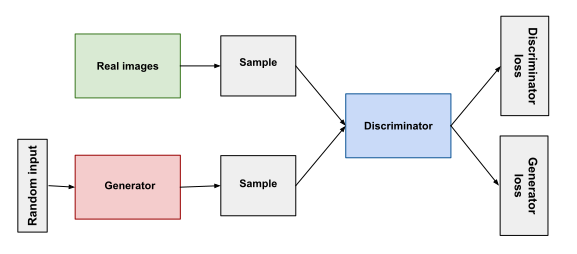
The process is iterative and competitive. The generator produces an image and shows it to the discriminator, which provides feedback on its flaws. The generator then adjusts its parameters and tries again, progressively improving its output. This cycle repeats potentially millions of times. The generator becomes more adept at creating realistic fakes and the discriminator becoming more skilled at detecting them. The process concludes when the generator’s output becomes so realistic that the discriminator can no longer reliably distinguish it from authentic data. This adversarial dynamic proved to be an incredibly powerful method for generating high-fidelity, realistic images.
Variational Auto-Encoder (VAE)
Alongside GANs, another deep learning architecture known as a variational auto-encoder (VAE) was also instrumental in early face-swapping techniques. An autoencoder learns to compress data into a compact, low-dimensional representation and then reconstruct it.

For face-swapping, two autoencoders are trained, one on images of the source face and one on the target face. By feeding the encoded representation of the source face through the decoder trained on the target face, a new image is generated. This generated image preserves the expressions and movements of the source but with the facial identity of the target. Creating a convincing deepfake video using these techniques typically involves feeding hundreds or thousands of images of both the source and target individuals. This is fed into the neural network to “train” it to reconstruct their facial patterns.
GANs and VAEs, coupled with open-source code and large datasets of images scraped from the internet, transformed deepfake creation. It went from a niche academic pursuit into an accessible, if still technically demanding, hobby. This marked the end of an era where high-quality visual manipulation was the exclusive domain of a handful of experts in Hollywood or government.
Diffusion Models
GANs powered the early deepfake explosion. The current cutting-edge in synthetic media generation has largely shifted to a newer, more powerful class of models. These models are known as diffusion models. This technology moves from the manipulation of existing media, like face-swapping. It advances to the creation of entirely new, complex, and coherent video scenes from scratch. These creations are guided by simple text prompts.
Diffusion models work through a process of iterative refinement. The generation process begins with a frame of pure random noise, like static on an old television screen. The model then gradually removes this noise over a series of steps. It progressively shapes the image to match the textual description provided by the user. This de-noising process allows for a much higher degree of control. It offers more coherence than was typically possible with GANs. This is particularly true when generating video.

Two of the most prominent examples of this new wave are OpenAI’s Sora and Runway’s Gen-2.
Sora by OpenAI for creating deepfakes
OpenAI’s Sora was unveiled in early 2025. It demonstrated a remarkable ability to generate high-fidelity video clips up to 1080p resolution from text prompts.
Sora builds upon the architectural foundations of large language models like GPT. It uses a transformer architecture that allows it to process and understand the relationships between different elements in a scene over time. A key innovation is its ability to consider multiple video frames at once. This solves a long-standing problem of temporal consistency. This allows Sora to keep the identity of an object or person even when they temporarily move out of view and then reappear.
Furthermore, Sora employs a “recaptioning” technique inherited from the DALL-E 3 image generator. Here, an advanced language model first elaborates on the user’s simple prompt to create a much more detailed description. This enriched prompt is then fed to the video generation model. This results in an output that more faithfully adheres to the user’s intent. Beyond pure text-to-video, Sora can also animate still images or take an existing video and extend it. This demonstrates a nascent but powerful understanding of how objects and forces interact in the physical world.
Gen-4 by Runway for deepfakes
Runway, a pioneer in generative AI tools, offers its Gen-4 model among over 30 ‘AI Magic Tools.’
Runway’s platform is explicitly designed to be accessible to artists, filmmakers, and designers without extensive programming knowledge. It provides multiple modes of creation. This includes text-to-video, image-to-video, text-plus-image-to-video, and stylization. The aesthetic of a source image can be applied to an entire video.
Runway integrates these generative capabilities directly into a cloud-based video editing timeline. This streamlines the creative workflow and further lowers the barrier to entry for producing high-quality synthetic content.
From GANs to diffusion models
This transition from GANs to diffusion models, and from face-swapping to full-scene generation, has profound implications. It marks the point where synthetic media technology has evolved from a tool of impersonation to a tool for world-building. The rapid progress in this domain reveals a troubling asymmetry at the heart of the modern information ecosystem.
The cost, time, and technical skills needed to create plausible, high-quality synthetic media are plummeting. This is further driven by user-friendly platforms like Runway and powerful models like Sora.
This “democratization” of content creation is leading to an exponential increase in the volume of synthetic media online. The number of deepfakes is doubling every six months.
At the same time, the cognitive and technological burden is increasing dramatically to curate this flood of information. They must verify its authenticity for the average citizen, journalist, and platform moderator. The easier it becomes to generate a fake, the harder it becomes for society to manage the output.
This dynamic ensures that the deepfake problem can’t be solved by detection technology alone. It requires a holistic approach that addresses the entire information pipeline, from creation to consumption.
Societal impact and malicious application of deepfakes examples in 2025

The proliferation of advanced synthetic media technology presents a classic dual-use dilemma.
The same tools that can be used for artistic expression, entertainment, and historical preservation can also be weaponized. They can commit fraud, spread disinformation, and inflict profound personal harm too.
A comprehensive understanding of the deepfake threat requires a systematic analysis of these malicious applications. One must move beyond theoretical risks to examine real-world incidents. It’s also essential to recognize the more damaging second-order effect: the erosion of shared, verifiable truth.
Yet, a balanced assessment must acknowledge the legitimate applications of this technology. It is crucial for developing nuanced policies that curb misuse without stifling innovation.
The threats from deepfake technology include several key vectors, each with unique targets and impacts:
Financial fraud and corporate espionage

The use of deepfakes for financial crime is one of the most immediate and tangible threats to both individuals and corporations.
Malicious actors are leveraging AI-generated voice and video to execute highly sophisticated social engineering attacks that bypass traditional security measures.
In a landmark case from February 2024, a finance worker at a multinational firm in Hong Kong was duped into transferring $25 million to fraudsters. The attack was initiated via a phishing email. But it escalated to a full video conference call. The victim saw and heard individuals he believed to be the company’s UK-based chief financial officer and other colleagues. In reality, every other participant on the call was a deepfake avatar.
This incident highlights a significant escalation in tradecraft. Email-based business email compromise (BEC) attacks are common. The use of real-time, multi-person deepfake video calls defeats standard security awareness training. This training advises employees to verify requests through a different communication channel. The video call was the second channel, lending a powerful and persuasive layer of authenticity to the scam.
This is not an isolated phenomenon. In a 2019 case, the CEO of a UK-based energy firm received a phone call. He recognized the caller’s voice as his boss, the chief executive of the German parent company. The voice clone requested an urgent transfer of €220,000 to a Hungarian supplier, which the CEO duly executed.
These attacks are not limited to high-level executives. Scammers are increasingly targeting the general public, with older adults being a particularly vulnerable demographic. One common tactic is the “grandparent scam.” Here, the criminal uses voice-cloning technology to impersonate a grandchild in distress. They claim to need money urgently for bail or a medical emergency. The FBI reported over $13 million in losses from such scams between January 2020 and June 2021.
Other scams involve deepfaked videos of celebrities like Elon Musk promoting fraudulent high-return investment schemes. This leads to devastating losses for victims who invest their retirement savings.
Political disinformation and electoral interference

The potential for deepfakes to disrupt democratic processes raises serious concerns for national security and intelligence agencies globally. Synthetic media can create false narratives, undermine trust in leaders, and manipulate public opinion.
The 2024 US election cycle saw several instances of this technology being deployed. In New Hampshire, residents received a wave of AI-generated robocalls featuring a convincing voice clone of President Joe Biden. It urged them not to vote in the state’s presidential primary. The immediate impact of this specific campaign was limited. Still, it served as a proof-of-concept for how easily and cheaply such tactics can be deployed at scale. These tactics can sow confusion and potentially suppress voter turnout.
The threat is global. During the early stages of the Russia-Ukraine conflict, a deepfake video circulated online. It depicted Ukrainian President Volodymyr Zelenskyy telling his soldiers to lay down their arms. The video falsely showed him asking them to surrender.
The real Zelenskyy quickly debunked the video. It showed how deepfakes can serve as psychological warfare tools to demoralize troops and civilians.
In Romania, there were severe concerns about foreign interference involving AI-driven disinformation. These concerns contributed to the nullification of the 2024 presidential election.

A significant danger of political deepfakes is their rapid spread on social media. By the time synthetic media is fact-checked and debunked, it may have been viewed by millions. This causes damage to a candidate’s character or fitness for office.

During India’s 2024 general election, parties used AI to create deepfake videos and audio. These featured Prime Minister Modi and deceased politicians endorsing campaigns. These realistic media pieces spread misinformation and manipulated public opinion. This piece by GNET highlighting the risks of deepfakes to democratic processes and election integrity.
Some analysts have argued that deepfakes have yet to be the single deciding factor in a major election. But their capacity to pollute the information ecosystem is undeniable and a threat. They also erode trust in the democratic process itself.
Harassment, defamation, and non-consensual pornography
One of the earliest, most widespread, and most personally devastating applications of deepfake technology is the creation of non-consensual pornography.
An estimated 96% of all deepfake videos online fall into this category, and they disproportionately target women. The technology is used to seamlessly map the faces of individuals. This includes celebrities, politicians, journalists, and increasingly, private citizens like classmates and colleagues—onto the bodies of actors in explicit videos.
This form of abuse is used for a variety of malicious purposes, including public humiliation, intimidation, blackmail, and sextortion. The psychological impact on victims can be profound, leading to severe emotional distress, reputational damage, and in some cases, self-harm. The accessibility of the technology has led to its use in more common forms of abuse, like cyberbullying among students.
In one reported case, students at a New Jersey school used AI tools to create and circulate pornographic images of their classmates.
The threat extends beyond pornography.
Deepfakes are used to create defamatory content. Like, a fake video of a business executive admitting to financial crimes or a political opponent making racist statements.
AI-generated audio has also been used in extremist propaganda. Like, a clip of actress Emma Watson’s voice being used to read Adolf Hitler’s “Mein Kampf” to promote Nazism. These applications shows the power of deepfakes to inflict targeted, severe, and lasting harm on individuals and groups.

The strategic threat landscape is also evolving. Early fears centered on the creation of a single, flawless deepfake that could fool a world leader or crash a stock market. The more immediate and pervasive danger may lie in the sheer volume of synthetic content. The widespread availability of generative AI tools is leading to a flood of low-to-medium quality synthetic media, or “AI slop”.
The number of deepfakes online is reportedly doubling every six months. It is creating a “firehose of falsehood” that aims not necessarily to convince, but to confuse and overwhelm. It exhausts the verification capacities of both individuals and institutions.
This shift from a targeted “sniper rifle” approach to a “shotgun blast” of content pollution changes the primary danger. It is not about being perfectly deceived by one fake. But being incapable of navigating an information environment where everything is questionable.
The liar’s dividend: The erosion of trust
The most insidious and long-term danger posed by deepfake technology is not the creation of fake content, but the power it gives liars to discredit authentic content.
This phenomenon, termed the “liar’s dividend” by scholars Danielle Citron and Robert Chesney. They describe a scenario where the mere possibility of a deepfake can be used to cast doubt on genuine video or audio evidence.
As public awareness of deepfakes grows, any incriminating or inconvenient piece of media can be plausibly dismissed as a sophisticated forgery.
Professor Hany Farid of UC Berkeley articulates the core of the problem:
“What happens when we enter a world where we can’t believe anything? Anything can be faked. The news story, the image, the audio, the video. In that world, nothing has to be real. Everybody has plausible deniability”.
Source: UCBerkeley
This creates a world where objective, verifiable reality becomes dangerously subjective.
This is not a hypothetical concern. In a recent court case, lawyers for Elon Musk suggested that past statements he had made about Tesla’s self-driving capabilities could have been deepfakes. This tactic, regardless of its success in that specific case, sets a dangerous precedent. Public figures, corporate executives, and criminals can claim genuine recordings of their actions or words are AI-generated hoaxes. This undermines the ability to hold them accountable.
The liar’s dividend threatens the very foundations of institutions that rely on a shared understanding of facts. This includes the justice system, journalism, and democratic governance. It fuels a broader crisis of media credibility. Increasing public skepticism makes citizens more vulnerable to deception and less willing to trust reliable sources.
The ultimate danger is not just that we will be fooled by fake content. We might live in a world where no content can be trusted. This erosion impacts informed public discourse and collective decision-making.
Deepfake technology benefits: Productive and creative applications
Although there are risks, synthetic media technology is not inherently malicious and has beneficial applications. Acknowledging this dual-use nature is essential for crafting regulations that effectively target harmful uses without stifling innovation.
In the arts and entertainment, deepfake technology has opened up new creative avenues.
The “Dalí Lives” exhibition at the Dalí Museum in Florida featured a life-sized, AI-powered recreation of the artist Salvador Dalí.

This would interact with visitors using quotes from his actual interviews and writings.
In filmmaking, the technology is used for a range of special effects. Like, seamlessly de-aging actors for flashback scenes. Or, digitally recreating actors who have passed away to finish a film, thereby maintaining a cohesive story.

In Here, advanced digital techniques help Tom Hanks and Robin Wright to portray their characters from their teenage years. This technology reflects a trend in Hollywood of altering actors’ ages. It raises new possibilities and concerns about the future of performance and casting.
The technology has also been used for powerful public awareness campaigns. In one notable example, a campaign to raise awareness about malaria featured soccer star David Beckham. He appeared to speak fluently in nine different languages, which dramatically broadened the reach and impact of the message.
In the realm of accessibility and health, AI voice synthesis has had life-changing impacts. The technology helped actor Val Kilmer regain his voice. He lost his ability to speak due to throat cancer. This was for his role in the film Top Gun: Maverick.
Furthermore, in gaming and virtual reality, the technology allows for greater personalization and immersion.
Companies like Modulate are developing “voice skins.” These allow users in online games to adopt different vocal personas. Users can still keep the natural emotion and cadence of their own speech. This offers new forms of self-expression in digital spaces.
These positive examples highlight the need for a nuanced approach to governance. This approach should focus on the intent and impact of the application. It should not focus on the technology itself.
The counteroffensive: The science of Deepfake detection
As tools for generating synthetic media have become more sophisticated, research in its detection has also evolved. This relationship between generation and detection shows an escalating arms race, with detectors continually adapting to new manipulations.
Early detection techniques aimed at identifying digital artifacts from GANs, like unnatural blinking or lighting inconsistencies. But, as generative models advanced, these flaws became easy to correct, making artifact-based detection less reliable.
As a result, the field has shifted toward more fundamental techniques of verifying authenticity.
Current research focuses on identifying inconsistencies with “ground truth,” which includes biological laws, real-world physics, or the statistical fingerprints of AI algorithms.
The Universal Detector: A deep dive into the UNITE Model
A recent breakthrough in this field is the development of the Universal Network for Identifying Tampered and synthEtic videos (UNITE) model. It is a project involving researchers from the University of California, Riverside, and Google.
The UNITE model is a major advancement, specifically targeting the shortcomings of earlier detection techniques in text-to-video generation.
You can read full AI research paper here: Towards a Universal Synthetic Video Detector: From Face or Background Manipulations to Fully AI-Generated Content
The problem with existing deepfake detectors

The vast majority of prior deepfake detection tools are fundamentally “face-centric”.
They were designed and trained to find the specific manipulations common in the first wave of deepfake. These include face-swapping, lip-syncing, and facial expression reenactments. A significant operational limitation of many of these tools is that they can’t do an analysis. The open-source DeepFake-O-Meter platform, for example, requires a human face to be detected in the video first.
This narrow focus renders them largely ineffective against the two most significant emerging threats in synthetic media:
- Non-Face Manipulations: Alterations to a video’s background, the removal or insertion of objects, or manipulations involving non-human subjects are overlooked. Face-centric detectors completely miss these changes.
- Fully AI-Generated Content: The new wave of text-to-video models like Sora and Gen-2 creates entire scenes from scratch. These videos may not contain any real footage. They may not even feature human faces. This places them entirely outside the operational scope of traditional deepfake detectors.
“People deserve to know whether what they’re seeing is real and as AI gets better at faking reality, we have to get better at revealing the truth.”
Rohit Kundu to ScienceDaily
This growing gap exists between the capabilities of generative models and detection tools. It created an urgent need for a more generalized, “universal” detector. This detector could analyze the entire video frame for signs of artificiality, and would work regardless of the subject matter.
The UNITE architecture and methodology

The UNITE model was engineered to fill this gap. It is a transformer-based architecture. This class of neural networks is highly effective at processing sequential data. They are ideal for analyzing the temporal relationships between video frames. Instead of focusing on cropped facial regions, UNITE analyzes full video frames. It looks at segments of 64 consecutive frames. This approach captures spatial inconsistencies, which are artifacts within a single frame. It also captures temporal inconsistencies, which are unnatural changes between frames.
The methodology incorporates several key innovations:
Domain-agnostic feature extraction (SigLIP-So400M)
A major challenge in deepfake detection is generalization.
A model trained on one dataset of fakes (e.g., from a specific GAN) often performs poorly on fakes created by a different, unseen method. To overcome this “domain gap,” UNITE does not learn visual features from scratch. Instead, it employs a powerful, pre-trained foundation model called SigLIP-So400M to extract high-level features from each video frame. This model is a Vision Transformer (ViT). It was pre-trained on a massive and diverse dataset of 3 billion image-text pairs. The Vision Transformer has learned a rich, generalized understanding of visual concepts. By using these pre-computed, “domain-agnostic” features as its input, the UNITE model becomes far more robust. It is better capable of detecting novel types of fakes it was not explicitly trained on.
The key innovation: Attention-diversity (AD) loss
The researchers discovered a critical problem with standard transformer models. Even when trained on full video frames, the model’s “self-attention” mechanism would naturally learn to focus almost exclusively on human faces. This mechanism is the process for deciding which parts of the input are most important. This meant the model was still ignoring potential evidence of manipulation in the background.
To solve this, they introduced a novel component to the training process called Attention-Diversity (AD) Loss.
This is a custom mathematical function that penalizes the model during training. This happens when its multiple “attention heads” (the parts of the transformer that learn to focus on different features) all converge on the same spatial region. The AD loss function encourages the attention heads to look at different parts of the frame. It forces the model to develop a more holistic understanding of the entire scene. This increases sensitivity to subtle inconsistencies. These would otherwise be missed, like mismatched lighting between a synthetically inserted person and their background. It also applies to unnatural motion patterns in a fully AI-generated landscape.
Diverse Training Data:
To build a truly universal detector, the training data must reflect the full spectrum of synthetic media. The UNITE researchers combined traditional face-manipulation datasets (like FaceForensics++) with a dataset of fully synthetic videos from the video game Grand Theft Auto V (GTA-V). The realistic gameplay footage from GTA-V, while not AI-generated, served as an effective proxy for fully synthetic worlds. It taught the model to recognize scenes that do not adhere to the physics and textures of reality.
Performance and significance
The results of the UNITE model were exceptional. On standard, face-centric deepfake datasets, it achieved state-of-the-art accuracy, ranging from 95% to over 99%. Its true breakthrough, but, was in its performance on the new classes of synthetic media. When trained with the diverse dataset, UNITE used the innovative AD Loss. It achieved a remarkable 100% accuracy on a dataset consisting of background-only manipulations. It also significantly outperformed all other evaluated detectors on fully synthetic videos, demonstrating the effectiveness of its full-frame analysis.
UNITE model marks a shift in detection strategy. It expands from a focus on facial artifacts to a comprehensive analysis of scene coherence. By generalizing beyond faces, it offers a robust defense against modern synthetic media, from face-swaps to fully AI-generated environments. This work lays a vital foundation for the next generation of detection tools necessary to combat the rise of synthetic media.
A comparative analysis of deepfake detection methodologies
The UNITE model, while representing the advanced in universal detection, is part of a broader ecosystem of diverse detection strategies. Understanding these different approaches is key to appreciating the multifaceted nature of the detection challenge.
Two other leading paradigms, Intel’s FakeCatcher and the DeMamba module, offer complementary strengths. They highlight the different “ground truths” that researchers use to anchor their verification techniques.
Biological Signal Analysis (FakeCatcher)
Developed by Intel Labs, the FakeCatcher platform seeks to verify authenticity by detecting the presence of immutable biological signals. Instead of looking for digital artifacts that show a fake, FakeCatcher looks for authentic “watermarks of being human” that prove a video is real.
The core technology behind FakeCatcher is photoplethysmography (PPG), the same principle used in medical pulse oximeters and fitness trackers. When the human heart pumps blood, the veins and capillaries in the skin change color very slightly as they fill and empty. This fluctuation is completely invisible to the naked eye. But it can be detected by analyzing the pixel values in a video of a person’s face. FakeCatcher’s algorithm analyzes multiple points on a subject’s face to extract these subtle PPG signals. In a real human, signals from different parts of the face are temporally consistent. They show a single, unified heartbeat. AI-generated deepfakes do not simulate this complex biological process. The absence of a coherent, pulse-driven color fluctuation across the face is a powerful and reliable indicator of a fake.
FakeCatcher boasts a 96% accuracy rate. Crucially, it is designed to work in real-time. It is capable of running up to 72 simultaneous detection streams on a single server. This enables it to screen user-generated content on social media effectively. It can verify the authenticity of news footage, and most importantly, detect deepfakes during live video conferencing calls. This tactic is already being used in high-stakes financial fraud.
The primary strength of this biological approach is its robustness. It is anchored in a fundamental aspect of human physiology that is extremely difficult for AI models to replicate.
Yet, its primary limitation is its scope: it is inherently human-centric. FakeCatcher requires a clear, well-lit view of a human face to function. It can’t detect synthetic landscapes, object manipulations, or any AI-generated video that does not feature a human subject.
Spatiotemporal Inconsistency Analysis (DeMamba)
The DeMamba module shows a more specialized approach, designed specifically to counter the new wave of fully generative models. Developed with GenVideo, the first million-scale dataset of AI-generated videos, DeMamba is a “plug-and-play” component. It is intended to enhance existing detectors. The module provides a powerful tool for analyzing the unique artifacts produced by text-to-video (T2V) and image-to-video (I2V) systems.

Unlike UNITE’s transformer, which looks at the entire frame, DeMamba leverages a structured state space model. This is a novel architecture known as “Mamba.” It efficiently analyzes how small, local zones of pixels change across both space and time. This allows it to capture the very subtle, fine-grained spatiotemporal inconsistencies that are characteristic of current generative video models. These might include tiny flickers. There could be unnatural texture warping during motion. Slight discontinuities in how an object moves from one frame to the next may also occur.
DeMamba’s specialization is both its strength and its weakness. It demonstrates superior generalizability and robustness on the GenVideo benchmark. It effectively identifies videos from unseen generators. The model performs well even when the videos are degraded by compression or low resolution. Still, as noted in the UNITE research paper, the DeMamba model was not evaluated on traditional face-swap datasets. This suggests its focus is squarely on the artifacts of fully synthetic content. It does not focus on partial manipulations like face swaps. DeMamba serves as a powerful tool. It complements a universal detector like UNITE. It provides a deep focus on the specific forensic signatures of the latest generative models.
Deepfake detectors and their approaches compared
These distinct approaches illustrate a sophisticated divergence in detection strategy. UNITE and its universal physical consistency check offer one method. FakeCatcher’s biological ground truth verification offers another. Finally, DeMamba’s targeted analysis of algorithmic artifacts adds a different layer.
The arms race is no longer simply about finding obvious “mistakes.” Instead, it has become a battle to set up and verify different forms of ground truth. FakeCatcher anchors itself in biological ground truth, a signal that AI does not presently replicate. UNITE learns the implicit rules of physical ground truth. It detects violations in the expected behavior of light, shadow, and motion within a coherent 3D space. DeMamba refines the search for algorithmic ground truth, identifying the subtle statistical fingerprints left by specific classes of generative models.
The future of robust detection will likely involve an ensemble of approaches rather than a single “magic bullet.” A suspicious video could be analyzed for biological consistency, physical consistency, and algorithmic consistency. This creates a multi-layered defense difficult for any generative technique to overcome. This suggests a future where authenticity is not merely real or fake, but a confidence score derived from multiple verification channels.
| Criterion | UNITE (Universal Network for Identifying Tampered and synthEtic videos) | FakeCatcher | DeMamba (Detail Mamba) |
| Core Methodology | Transformer-based full-frame analysis of spatial and temporal inconsistencies. | Biological signal analysis via Photoplethysmography (PPG) to detect blood flow. | Structured state space model analyzing spatiotemporal inconsistencies in local pixel zones. |
| Primary Target | Universal: Face swaps, background manipulations, and fully synthetic (T2V/I2V) videos. | Human-centric: Portrait videos where a human subject is clearly visible. | AI-Generated Video: Specifically designed for content from T2V and I2V models. |
| Key Innovation | Attention-Diversity (AD) Loss: Forces the model to analyze the entire video frame, not just faces. | Use of PPG: Anchors detection in a biological signal that AI models do not replicate. | Plug-and-play module: A specialized component to enhance existing detectors against generative video. |
| Strengths | High generalizability across all types of synthetic media; does not need a face to be there. | High accuracy (96%) in real-time; difficult for forgers to replicate the biological signal. | Strong performance and robustness against novel and degraded AI-generated videos. |
| Limitations | Potentially higher computational cost; real-time application is a future goal. | Ineffective for non-human subjects, synthetic landscapes, or background manipulations. | Not evaluated on traditional face-swap datasets; focused primarily on T2V/I2V artifacts. |
How to spot a deepfake?
Amid the discussion of sophisticated AI detectors, it is critical to tackle the role and limitations of human perception.
Online guides have emerged to teach the public “how to spot a deepfake.” They highlight visual cues like unnatural blinking, jerky movements, and poor lip-syncing. While these tips may help find low-quality fakes, relying on them as a primary defense is ineffective and dangerous.
Experts in the field are unanimous in their assessment: the average person can’t reliably detect a high-quality deepfake. Attempting to do so often creates a false sense of security. Dr. Hany Farid, a leading digital forensics expert, states the matter bluntly:
You won’t be able to tell. And even if I could tell you something today that was reliable, six weeks from now, it’ll not be reliable and you’ll have a false sense of security. So, I get this question a lot, and the thing you have to understand is this is a hard job. It is really hard to do this, and it’s constantly changing.
And the average person doom scrolling on social media cannot do this reliably.
You can’t do it reliably. I can barely do it reliably, and this is what I do for a living.
The reason for this is simple: the detection arms race is dynamic. Any observable artifact that becomes a known “tell” for a deepfake is quickly identified by the creators of generative models. They then update their algorithms to remove that specific flaw. For example, early deepfakes often featured subjects who didn’t blink. Once this became a widely publicized detection tip, developers trained their models on data that included blinking. As a result, the artifact disappeared.
The only truly reliable approach for the public is not to focus on pixel-level analysis. Instead, it is to practice fundamental media and information literacy. This involves a shift in mindset from trying to debunk the content itself to critically evaluating its context:
- Question the source: Who created this video? Is it a reputable news organization or an anonymous account? A video of Tom Cruise on an account named
@deeptomcruiseis an obvious clue. - Verify through trusted channels: If a shocking video of a public figure emerges, look for reports from established news outlets. Make sure they are credible sources.
- Look for corroboration: Use tools like reverse image search. Check if frames from the video have appeared elsewhere. They may show up in a different context.
- Be wary of emotional manipulation: Deepfakes are often designed to provoke a strong emotional response. This could be outrage or fear. The goal is to encourage rapid, uncritical sharing. A sense of urgency is a major red flag.
The key takeaway is that deepfakes are a technological problem that requires a technological solution for verification. The best defense for the human consumer of information is to become more critical. They should be cautious and informed digital citizens rather than forensic analysts.
Ultimately, the very “liar’s dividend” that poses such a threat to our information ecosystem may also catalyze its own solution. As trust in unverified digital content collapses, it creates a powerful commercial and strategic imperative for technologies of proactive authentication. The value proposition for cybersecurity and information services will shift from simply “detecting fakes” to definitively “proving authenticity.”
Corporations, governments, and news organizations that rely on public trust must use technologies like digital signatures, cryptographic watermarking, and blockchain ledgers to verify their communications.
This will likely lead to the emergence of a two-tiered information ecosystem:
- A baseline of unverified, untrusted content
- A parallel sphere of high-stakes communication built on a new infrastructure of verifiable, cryptographically secured ground truth.
Navigating this new reality will be the defining information security challenge of the coming decade.
Learn more about useful AI models
Explore below AI research paper explainers and trends in AI models:
- Why GPT-5 Launch Failed: User Feedback Analysis [Reddit/X vibe checks + expert reviews]
- Microsoft AI-Safe Jobs Study Explained: Use Insights to AI-Proof Career in 2025
- Best AI Browsers: Free Comparison Business Analysis Report
- MIT ChatGPT Brain Study: Explained + Use AI Without Losing Critical Thinking
- Gemini 2.5 Pro Preview: Best AI Coding Tool For Developers
- How AI for Consulting Reshapes Strategy Consulting Jobs in 2025
- Vertical AI Agents Will Replace SaaS – Experts Warn On Future Of Workflow Automation
- ChatGPT vs Gemini 2.5 Pro – Analyzing Reddit And Expert Reviews
Get more simplified AI research papers, listicles on best AI tools, and AI concept guides, subscribe to stay updated:
This GPT-5 review analysis is written using resources of Merrative. We are a publishing talent marketplace that helps you create publications and content libraries.
Leave a Reply