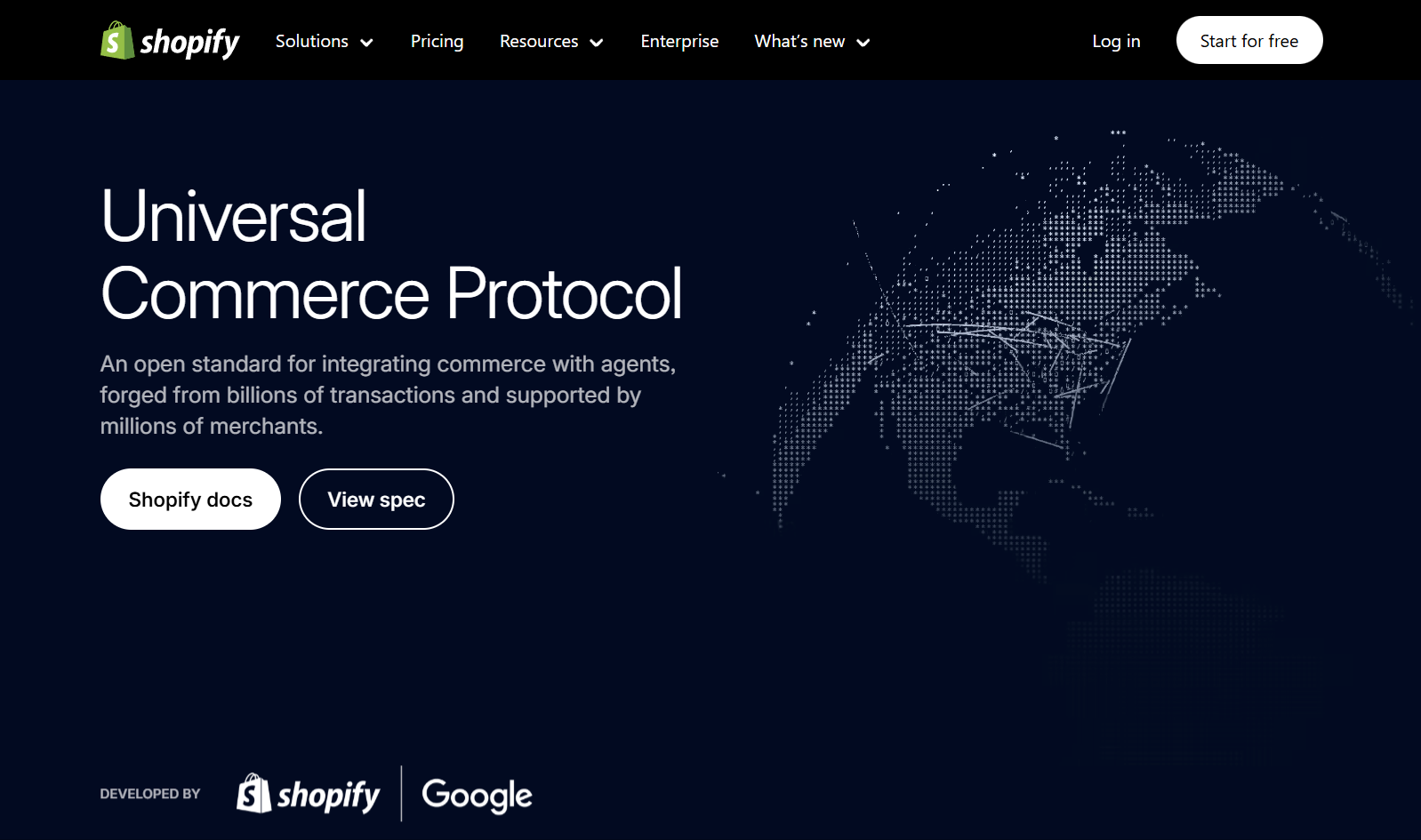
At the National Retail Federation’s ‘Big Show’ in New York, Google and Shopify made a significant announcement. They officially introduced the Universal Commerce Protocol (UCP). This is an open-source standard. It is designed to let AI agents handle the entire shopping journey across different retailers.
This new protocol allows consumers to discover products and build a cart. They can finish payment directly within a chat interface like Google Search (AI Mode) or the Gemini app. They never have to visit a merchant’s website.
Backed by industry giants like Walmart, Target, PayPal, and Visa, UCP aims to solve the fragmentation of ‘Agentic commerce’ while ensuring merchants keep full control over their customer data and pricing logic
3 Key Takeaways
- Unified Shopping Standard: UCP is a standardized language that allows AI agents to seamlessly interact with any retailer’s backend. This enables discovery and checkout across the web without requiring custom integrations for every store.
- Merchant Control: Unlike aggregators that hoard data, UCP ensures the retailer remains the Merchant of Record. The retailer owns the customer relationship, pricing, and fulfillment decisions.
- Direct AI Checkout: The protocol powers a native checkout experience in Google AI Mode and Gemini. It allows users to buy from stores like Shopify merchants instantly. They can use saved credentials in Google Pay.
What is UCP? – The Engine of Agentic Commerce
The Universal Commerce Protocol (UCP) addresses a critical “N x N integration bottleneck” that has historically made it difficult for AI agents to shop at multiple stores
A Protocol to Cover All Commerce

UCP is an open-source standard. It defines how commerce actions, like searching for a product, are communicated between an AI agent and a business. It also outlines how adding a product to a cart is managed. Additionally, checking out is part of this communication process. Retailers no longer need to build a unique connection for every platform.
By implementing UCP once, they can be accessible to any AI agent that speaks the language. This standardization covers everything from product discovery to post-buy support, like tracking and returns
Empowering Serendipity
During the launch demo, Shopify CEO Tobi Lütke emphasized how this technology brings “serendipity” back to shopping.
“This is one of the really exciting parts about agentic… It’s really good at finding people who have specific interests and finding the product that is just perfect for them. Like, I would have never searched for this product, but somehow it found me right on the other side. This serendipity is where the best of commerce happens.”
— Tobi Lütke, Shopify CEO and founder. [Source: TechCrunch]
Integrate with Google: Direct Selling in AI Mode
For retailers, the immediate advantage of UCP is the ability to sell directly on Google’s most advanced surfaces
Direct Selling in Google AI Mode and Gemini App

The protocol enables Direct selling in Google AI Mode. It achieves this by allowing the AI to show buy options natively in the Gemini app. This addresses newer consumer behavior, which has shifted toward more conversational commerce.
“Today’s shoppers expect to go from search to purchase in a single conversation,”
—- Nayna Sheth, Head of Product for Agentic Payments, Microsoft. [Source: Shopify]
Branded Business Agents

Merchants can integrate AI-powered Business Agents within Google Search to answer customer questions. Examples of this include retailers like Lowe’s, Michaels, Poshmark, and Reebok, who are using the technology to offer branded support.
“We want retailers to be able to connect to users on our surfaces but using their own voice.”
— Vidhya Srinivasan, VP of Google ads and commerce. [Source: CNBC]
How UCP will Benefit the Entire Commerce Ecosystem?
UCP was designed as a ‘matchmaker’ protocol, ensuring value for both buyers and sellers without one side dominating the data.

Flexibility for Businesses
The protocol offers flexibility, allowing businesses to “pick and choose” what they want to implement. This means retailers can decide exactly how their inventory and pricing are exposed to AI agents.
“Businesses can pick and choose what they want so there’s flexibility for them.”
— Vidhya Srinivasan, VP of Google ads and commerce. [Source: CNBC]
The Matchmaker Role
Google views its role in this ecosystem as a ‘matchmaker,’ facilitating connections rather than owning the inventory. This approach is part of Google’s broader bet on AI in retail. Google aims to capture a projected $3 trillion to $5 trillion global opportunity. This approach is part of Google’s broader bet on AI in retail to capture a projected $3 trillion to $5 trillion global opportunity
The protocol offers flexibility, allowing businesses to “pick and choose” what they want to implement. This means retailers can decide exactly how their inventory and pricing are exposed to AI agents.
“Our role in the ecosystem is that of a matchmaker and one way is with ads.”
— Vidhya Srinivasan, VP of Google ads and commerce. [Source: CNBC]
Google UCP Partners: PayPal, Visa, and Shopify Agentic Commerce
The rollout of UCP includes a significant list of partners, ensuring it can handle payments and inventory at scale.
Major Retailer Adoption

Source: Shopify
The protocol was developed in collaboration with Shopify, Etsy, Wayfair, Target, and Walmart. This diverse group ensures the standard works for different types of merchants. It serves massive big-box stores as well as individual crafters on Etsy.
Payment Integration
While specific payment details are evolving, the system is designed to work with the broader agentic ecosystem.
“It’s a really big focus for us to innovate in the space that adds value to both retailers and buyers.”
— Vidhya Srinivasan, VP of Google ads and commerce. [Source: CNBC]
Risks and Opportunities with Google UCP: Personalization and Privacy
The capabilities of UCP bring significant benefits but also introduce new dynamics in how products are marketed.
Learn more: The agentic commerce platform: Shopify connects any merchant to every AI conversation
Dynamic Offers and Discounts
A key opportunity for retailers using UCP is the ability to offer special discounts to users during AI-driven product recommendations. This setup enables “dynamic negotiation.” Merchants and agents declare the commerce capabilities they support, such as discounts, loyalty programs, or subscriptions. The protocol negotiates the difference without needing a custom integration meeting. For example, a customer can submit discount codes in the chat. They can also input loyalty credentials directly to receive personalized pricing instantly.
Privacy Considerations
While this level of personalization is powerful, UCP is designed to keep merchants in control of their customer relationships. The protocol ensures that merchants keep ownership of their data. They also keep control of their business logic. This approach prevents surrendering it to an aggregation platform. Google emphasizes its role as a “matchmaker.” It facilitates connections between retailers and shoppers. Yet, it does not take over the merchant’s direct relationship with the consumer.
Additionally, UCP supports secure credential flows, ensuring that sensitive user data like payment information is handled securely through established protocols.
Community Reactions
Optimism for Brands

“Not nothing. Google and Shopify Launch Universal Commerce Protocol for AI agents. Top quality frontier models that users trust to be truth seeking will hugely benefit brands with genuine innovative products that shine because consumers love them, not because of massive marketing budgets and paid ads. Conversely brands that rely on dominating eyeballs via traditional and social media platform ads are on notice.”
The End of Friction

“Yesterday Shopify announced the Universal Commerce Protocol—built with Google. Consumers can now discover, negotiate, and buy products entirely inside AI conversations. No landing pages. No forms. No cart abandonment emails. Just… resolution.”
Economic Predictions

“Google just launched UCP (Universal Commerce Protocol). It is a standard that lets AI agents shop across any retailer without custom integrations… McKinsey predicts AI agents will handle 50% of online shopping by 2030, generating $3-5 trillion globally early tests cut transaction times by 30%”
Digital Marketing Concerns

“Google has just launched Universal Commerce Protocol (UCP). It enables online shoppers to complete the entire shopping process from product selection to payment check out within the platform. Shoppers do not need to visit the e-commerce portal. Open AI has also launched similar features few days back. So as Digital Marketers how do you see your role especially in this evolving Ecommerce space?”
Action Points — How to Get Started with Google UCP
- For Retailers: If you are a Shopify merchant, check the platform’s new AI settings. This ensures your store is prepared for Google agentic shopping.
- For Brands: Consider setting up campaigns in Merchant Center to offer special discounts for specific AI-driven queries
- For Developers: Explore the compatibility of UCP with Agent2Agent (A2A) and Model Context Protocol (MCP) to build custom shopping agents
- For Consumers: Look for new chat-based buying options in Google Search to test the “serendipitous” shopping experience
FAQs
What is UCP?
UCP is an open-source protocol that allows AI agents to handle discovery, buying, and support across retailers without custom integrations
Who created UCP?
Google and Shopify launched the protocol, along with partners like Walmart and Target.
Does UCP work with Google Search?
Yes, UCP enables direct selling in Google AI Mode and the Gemini app.
What is a Business Agent?
A Business Agent is a branded AI within Google Search that retailers like Lowe’s use to answer customer questions.
Is UCP free?
It is an open-source standard, meaning the protocol itself is free to use for development.
How does UCP help with payments?
It facilitates the shopping process, often utilizing saved payment credentials in platforms like Google Pay.
What retailers are using UCP?
Launch partners include Walmart, Target, Etsy, Wayfair, Lowe’s, Michaels, and Reebok.
Can AI negotiate prices?
Yes, the protocol allows retailers to offer special discounts during AI-driven interactions.
What is agentic commerce?
It refers to commerce where AI agents handle tasks like finding products and completing purchases on behalf of the user.
Does UCP handle returns?
Yes, it is designed to handle “post-purchase support,” which includes tasks like tracking and returns.
Is my data safe with UCP?
Google claims UCP allows merchants to connect without losing control of their data or customer relationships.
Does UCP work on mobile?
Yes, it powers experiences in the Gemini app, which is mobile-focused.
What UCP ‘serendipitous’ shopping?
The AI can find the perfect product for a user. This is true even if they didn’t explicitly search for it by name.
How do I enable UCP on Shopify?
Shopify has integrated the technology, so merchants should check their platform updates for “agentic” features
What is the NRF?
The National Retail Federation, where this announcement was made at their annual “Big Show” in New York.
Further Reading
Official Sources:
- Shopify Engineering: Building the Universal Commerce Protocol
- Shopify News: The agentic commerce platform
- Google for Developers: Under the Hood: Universal Commerce Protocol
Learn more about Google AI:
- Google Photos AI: 6 Hacks With Gemini and Nano Banana
- NotebookLM Slide Decks: Reddit Reviews + Example Prompts
- Google Maps AI Tools Explained: Unlock 6 New Features Today
- Claim Free Gemini 3 via Jio Promo Offer in India – Free Deep Think + Nano Banana
- Google Releases LangExtract: Explained + Getting Started FAQs Solved
- Google Veo 3: Advanced AI for Filmmaking With Examples
- Google Cloud AI for McDonald’s – Risks and Customer Experience Efficiency
- Gemini 2.5 Pro Preview: Best AI Coding Tool For Developers
We will update you more about such AI news and guides on using AI tools, subscribe to our newsletter shared once a week:
This blog post is written using resources of Merrative. We are a publishing talent marketplace that helps you create publications and content libraries.
Get in touch if you would like to create a content library like ours. We specialize in the niche of Applied AI, Technology, Machine Learning, or Data Science.
Leave a Reply