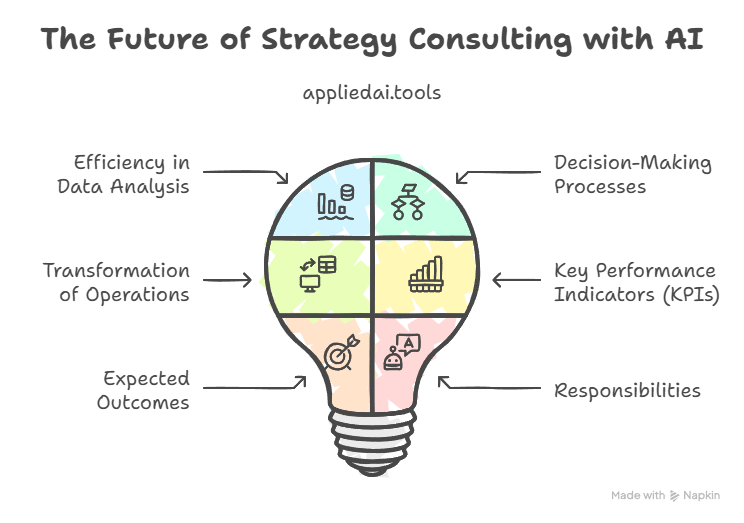
I think AI will not kill consultant jobs. The efficiency that AI brings in data analysis and decision-making will impact consulting roles in 2025. It will revamp consulting operations, their KPIs, expected outcomes, and responsibilities.
I have already covered how to use Generative AI for consulting. It lists various use cases and AI tools for consulting one can explore. This was published in November 2023, when leading management consultancies released ‘what if’ scenarios of AI adoption for consulting.
Fast forward to 2025, I came across the news of Pentagon cancels the $5.1 billion contracts in IT and consulting. This has started the chatter again about security and the payment offered in consulting jobs in 2025.
Further, I also covered opinions shared by Nandan Nilekani, co-founder of Infosys, on why scaling AI for enterprises is hard. One of the points was about ‘taking the blame or responsibility’. One can’t blame or make AI responsible if something goes wrong. One can extend the role of AI consultants, IT, or management consultancies to take up this role.
Hence, don’t expect AI to make consultants obsolete entirely. Instead, prepare for a significant transformation in
- How consulting work gets done in the age of AI?
- What skills are most valuable for AI in consulting?
- Who succeeds in this evolving landscape of consulting due to AI?
AI, particularly Generative AI (GenAI) tools like ChatGPT or proprietary platforms (like McKinsey’s Lily), is rapidly automating routine tasks. Activities like data crunching, basic research, and transcription are increasingly handled by intelligent systems. First slide creation, once the bread-and-butter of junior consultants (the ‘grinders’), is also managed by these systems.
This AI automation in consulting roles directly impacts the traditional consulting pyramid.
While it creates pressure on entry-level roles, it simultaneously demands that all consultants, from analysts to partners, elevate their game.
Broadly, here are the pros and cons of using AI for strategy consulting:

The focus shifts dramatically towards skills AI can’t easily replicate:
- Deep strategic thinking
- Complex problem-solving in ambiguous situations
- Fostering client trust and managing relationships
- Navigating organizational politics
- Ensuring ethical AI deployment
- Providing high-level guidance on AI strategy and implementation.
Consultants in 2025 must become adept collaborators with AI. They should use AI as a “superpower” to generate deeper insights faster. This approach is preferred rather than simply relying on old models of information asymmetry.
The bottom line is clear: AI is changing the consulting profession profoundly. This demands adaptation and a focus on uniquely human capabilities augmented by technological prowess.
In this blog post, I will not complain or give you anxiety on your consulting job security. I will also share solutions on how you can augment AI for consulting jobs. Learn from how current consulting companies are adopting AI and a overview of consulting job roles in 2025.
Key Takeaways:
- Skill Shift in Consulting Jobs: Demand is shifting from traditional analysis and slide-making towards AI literacy. This includes prompt engineering, data interpretation, ethical AI deployment, and change management. It also includes uniquely human skills like critical thinking, creativity, and complex client relationship management.
- Strategy Consulting Business Model Transformation: The traditional leverage model (finders, minders, grinders) is eroding. Firms are moving towards outcome-based pricing, AI-powered service delivery, and smaller elite teams. It also involves selling AI strategy/integration services, challenging the billable hour and information asymmetry advantages.
- Impact on Consulting Roles & Hiring: AI significantly impacts entry-level roles traditionally focused on research and analysis. Hiring shifts towards experienced specialists, AI-savvy talent, and those with strong interpersonal skills, potentially shrinking traditional campus recruitment pipelines.
How AI is shaping the strategy consulting landscape?
The world of strategy consulting is no longer just contemplating AI. It is actively integrating AI into the core fabric of its operations.
Major firms are not resisting the technology that threatens to erode traditional advantages. They are doubling down.
They view AI, especially Generative AI (GenAI), as a critical tool for maintaining a competitive edge. Still, it introduces new complexities and challenges.
Top consulting firms like McKinsey, Boston Consulting Group (BCG), Bain & Company, Deloitte, and Accenture are leading the charge. They are embedding AI deep within their workflows. This isn’t just superficial adoption; it involves significant investment in both proprietary platforms and partnerships with leading AI developers.
How is McKinsey using AI?
McKinsey has developed “Lily,” its own generative AI platform. It is designed to work flexibly with various Large Language Models (LLMs), including those from OpenAI.
“Lilli was born from the question: “How do we help our colleagues at McKinsey access the deepest and broadest array of our best insights so they can activate them with our clients?” And from there, as we started that investigation, ChatGPT exploded.
And we had this notion of, “What if we train it on our own information?” Lilli started as a knowledge extraction and synthesis tool, but to your question, it has now become an orchestration layer that basically coordinates many different types of knowledge across and outside the firm.”
– Erik Roth, Senior Partner at McKinsey
Listen to the full podcast to learn more about McKinsey’s Gen AI – Lily
Reports suggest over 70% of its employees use Lily, aiming to cut research and synthesis time significantly.
The Economist has covered about impact of AI on McKinsey’s business:
How is Boston Consulting Group using AI?
Boston Consulting Group has been collaborating with OpenAI since 2023, using tools like ChatGPT Enterprise. They also use specialized tools like “Deep Research.” This AI is designed to scan vast amounts of information (text, images, PDFs) from the web. It generates in-depth reports on complex topics. Furthermore, BCG enables consultants to build thousands of custom GPTs tailored for specific client engagements or internal tasks.
Internal studies show up to 40% efficiency boost in simple tasks with AI, though complex tasks still require human oversight.
Here are some examples of BCG’s efforts on adopting AI for consulting:
- Enterprise GPT Tools: Automating tasks like summarizing, transcribing, and drafting, significantly cutting down project time. This has significantly reduced the time required for these activities—from weeks to just a few days.
- ‘Gene’ AI Assistant: An evolving conversational AI used in events and client interactions.
How is Bain & Company using AI?
Bain and Company and OpenAI have partnered to integrate AI capabilities into their service offerings. They even advised clients, including IT service companies, on how to use and upsell AI solutions.
- New AI innovation hub: A dedicated OpenAI Center of Excellence aims to lead the development and delivery of AI solutions. This center will serve as a hub for innovation, supporting clients in extracting maximum value from their AI investments.
- Industry-Specific Solutions: The firms are co-creating AI tools tailored to sectors like retail and life sciences.
- Company-wide AI Access: All 13,000 Bain consultants now have access to ChatGPT Enterprise, embedding AI into daily workflows.
Deloitte and Accenture are similarly investing heavily in adopting AI for itself and their clients using dedicated Applied AI units.
AI for consulting is a double-edged sword: balancing efficiency vs. risks
The primary driver for rapid AI for consulting adoption is undeniable: efficiency.
AI promises, and often delivers, significant speed advantages. Yet, this pursuit of speed introduces significant challenges.
While managers often see the impressive final output and champion AI’s effectiveness, consultants on the ground report frustrations. They describe spending considerable time wrestling with AI prompts to get usable drafts. Then, they spend hours fixing errors or refining generic outputs. They feel that this time could have been better spent thinking critically from the start.
There’s a growing concern that the push for AI-driven speed is sidelining deep thinking and creativity. Timelines are shrinking dramatically, leading to rushed work and potentially superficial insights packaged in impressive-sounding language.
A BCG study even found that GenAI boosted performance on creative tasks. But it decreased performance on complex business problem-solving tasks by 23%. This decline occurred partly because consultants either over-trusted AI where it was weak. They also under-trusted it where it was strong. This highlights a crucial tension: the risk of sacrificing analytical rigor and genuine insight at the altar of AI-powered efficiency.
The pressure from the top is palpable. Consultants are reporting being explicitly discouraged from first-principles thinking and instead directed straight to AI tools. As one McKinsey consultant shared:
“My manager does not even ask me to do the task anymore. They just say ‘Get Lily to do it.’”
Quote source: Daybreak by The Ken
This approach risks devaluing the critical thinking process. This further leads to lower-quality, less nuanced outcomes, even as it accelerates parts of the workflow.
How AI adoption impacts consultant job roles?
The traditional structure of consulting firms is often visualized as a pyramid.

Partners are at the top. Managers are in the middle. A broad base of junior associates or analysts is at the bottom.
This structure is facing a seismic shift due to AI.
AI’s capabilities directly target the tasks that historically formed the foundation of this pyramid. This situation forces a re-evaluation of roles at every level – let’s understand how:
The squeezed bottom: ‘Grinder’ roles under pressure
The most immediate and profound impact is felt at the entry level.
Junior consultants are often referred to as ‘grinders’ in the classic model described by David Meister. They traditionally spent much of their time on research, data collection, and analysis. They also created presentations.
Learn more about grinders here: The Anatomy of a Consulting Firm by David Meister
But, these are tasks that AI, particularly GenAI, can now do with increasing speed and skill. Firms readily admit AI significantly reduces the time needed for these activities.
As Columbia professor Rita McGrath points out,
“…if you can push a button and get the answer to an analytical question in a matter of seconds, why would you pay for that kind of consulting?”
– Quote Source: Rita McGrath (Columbia Professor, Author and Founder of Valize) on The Future of Consulting in an Age of AI by The Innovation Show with Aidan McCullen
This automation leads to tough questions about the necessity of large incoming analyst classes performing this work.
Some insiders report that roles cut in prior years haven’t been refilled. Campus hiring has become lighter. Firms are leaning more on lateral hires with existing experience.

While firms still need to train future leaders, they are exploring concepts like ‘purposeful toil.’
They make sure junior staff engage meaningfully with analysis and validation. This engagement occurs even when AI provides the first draft, they build essential intuition and sanity-checking skills.
Still, the traditional ‘up-or-out’ path, reliant on using large numbers of junior staff, faces significant disruption.
Evolving senior roles: from oracles to orchestrators
Senior consultants and partners aren’t immune to change, but their roles are evolving rather than disappearing.
Historically, senior value often lay in experience, access to proprietary data, and providing definitive answers—acting as “oracles”. AI diminishes the value of proprietary data and information asymmetry. Clients today are armed with their own data and AI tools. They increasingly expect collaboration and co-creation rather than just receiving wisdom from on high.
The senior consultant’s role shifts towards becoming an orchestrator and strategic guide. This involves:
- AI strategy and oversight: Helping clients define their AI strategy, select appropriate tools, and navigate ethical considerations.
- Complex problem-solving: Tackling highly complex, ambiguous strategic challenges where AI provides data, but human judgment and creativity are paramount.
- Change management: Guiding organizations through the difficult process of adopting AI, redesigning workflows, and managing the human impact.
- Quality assurance: They use their deep experience to confirm AI outputs. They find subtle biases or errors. They make sure the advice delivered is sound.
- Relationship building: Deepening client trust and collaboration, which remains a uniquely human ability.
The rise of the ‘Specialist Consultant’
Alongside the evolution of traditional roles, AI is fueling demand for specialist consultants. These individuals combine deep skill in specific areas with a strong understanding of AI applications:
- AI technologists: Consultants have backgrounds in data science, machine learning, and AI development. They can help build, implement, and manage AI solutions.
- Industry experts with AI acumen: Professionals who deeply understand a specific sector (e.g., healthcare, finance, manufacturing) and can find and implement high-value AI use cases within that context.
- Ethical AI and governance specialists: Consultants focused on the increasingly critical areas like responsible AI deployment and bias mitigation. They also deal with data privacy and regulatory compliance.
So, if you are a newbie wanting to get a consulting job, better focus on developing skills in artificial intelligence.
Firms are adapting their hiring strategies. They are bringing in more technical talent laterally. The creation of ‘expert tracks’ values deep specialization alongside traditional consulting paths. This signifies a move towards more diverse teams. In these teams, traditional MBAs work alongside technologists, data scientists, and social scientists. They tackle complex challenges – all infused with AI.
Skillsets for the consultant jobs in 2025 – blending human insight with AI
As AI takes over routine analytical tasks, the value proposition for strategy consultants in 2025 shifts dramatically.
The skills required for a consultant moves towards capabilities that stay uniquely human.
These capabilities are augmented by a strong understanding of AI itself. Success will hinge on blending deep human insight with proficient AI collaboration.
Core human skills: The irreplaceable differentiators
With AI handling much of the “what” (data analysis, information synthesis), human consultants must excel at the “why” and “how.”
Skills often labelled ‘soft’ will become hard requirements!
Critical thinking and complex problem-solving:
Consultants need to go beyond accepting AI outputs. They must rigorously question assumptions and find potential biases in AI analysis. It is important to understand the context AI might miss. They must frame strategic problems in ways AI can effectively tackle. This involves dissecting complex, ambiguous situations where standard frameworks fall short.
Creativity and strategic imagination:
AI can generate options based on existing patterns. Yet, true strategic breakthroughs often need human imagination. This involves envisioning entirely new possibilities, business models, or solutions that aren’t simple extrapolations of the past.
Emotional intelligence and relationship building:
Establishing trust and navigating internal politics remains firmly in the human domain. Understanding client needs beyond the explicit brief is essential. Persuading stakeholders and managing difficult conversations is also crucial for humans. It is critical to learn how to build strong and trust-based relationships more than ever.
Communication and storytelling:
Learn how to translating complex, potentially AI-derived insights into clear, compelling narratives. These must resonate with diverse audiences and drive action.
Ethical judgment:
As AI becomes more embedded, consultants face several ethical dilemmas. They must tackle data privacy and algorithmic bias concerns. Additionally, they need to consider job displacement and the responsible deployment of powerful technologies.
As Alex Osterwalder, CEO of Strategyzer, highlighted in ‘The Future of Consulting in an Age of AI,’ many crucial human capabilities are underdeveloped by traditional education:
“What we do not educate at school are the human aspects… How do I understand my emotions, deal with my emotions… how do I have a conflict with colleagues… what is uniquely human, which AI can’t do today is not taught at schools.”
These skills are now central to a consultant’s value.
Build change management expertise:
Understand that implementing AI solutions is as much about managing people and processes as it is about technology. Develop skills in guiding clients and teams through the adoption of new AI-driven workflows and addressing resistance.
Work on AI literacy to work with the machine
Collaborating effectively with AI requires a new layer of technical understanding:
Understand AI concepts:
Consultants don’t need to be coders. But they must grasp core concepts like Generative AI, Large Language Models (LLMs), or machine learning principles. Explore he difference between various AI tools to use them appropriately.
Of course, you can subscribe to Applied AI Tools to learn practical application of AI tools and models:
Learn prompt engineering:
Getting useful output from GenAI tools requires skill in crafting clear, specific, and effective prompts. This is becoming a key competency – knowing how to ask the right questions of the AI.
Here are few resources we have published: Learn Prompt Engineering
Learn how to interpret AI model output and how to check it:
A crucial skill is critically evaluating AI-generated content. This means:
- Find potential inaccuracies (“hallucinations”)
- Recognize biases learned from training data
- Compare AI outputs against real-world knowledge
- Know when not to trust the AI.
For example, know when an AI code suggestion needs careful checking. Or learn to spot when a market size estimate seems illogical requires human oversight.
I have shared breakdowns of AI models in simple language: Learn how AI models work
Data privacy and AI ethics awareness:
Obviously, understanding the rules and best practices around using client data with AI tools is non-negotiable. Learn how to recognize potential ethical pitfalls and take precautionary measures.
Aspiring consultants in age of AI must learn agility
Perhaps, the most critical meta-skill is the ability and willingness to constantly learn and adapt.
AI technology is evolving at lightning speed. Consultants must embrace a mindset of continuous reinvention. Actively seek out new knowledge, experiment with new tools and techniques, and readily adapt approaches as the landscape shifts. Curiosity and the ability to learn from experience and feedback are vital for navigating this dynamic environment.
Beyond billable hours: Impact of AI on the consulting business model
AI isn’t just changing how consultants work; it’s fundamentally altering the business of consulting itself.
The traditional models that have defined the industry for decades are buckling under the pressure and opportunity presented by AI. This forces firms to rethink how they create, deliver, and capture value.
From hours to outcomes: The end of an era?
The long-standing practice of billing clients based on hours worked, is now facing intense scrutiny. AI significantly speeds up tasks like research, analysis, and content creation. So now it becomes increasingly difficult to justify high hourly rates. Machines can do these tasks faster.
Clients, particularly AI literate ones, are questioning the value derived solely from time spent. This is pushing the industry towards outcome-based pricing, where fees are tied to achieving specific, measurable results for the client.
This includes models like:
- Performance-based contracts
- Value-based billing
- Shared risk/reward arrangements
In these business models, the consulting firm puts ‘skin in the game.’ They will share the financial upside (or downside) of their strategic recommendations.

We see this pressure acutely in areas like government consulting.
Mandates are emerging to move away from time-and-materials. The shift is towards performance and taxpayer-friendly pricing. This shift fundamentally changes the consultant-client dynamic from a service provider paid for effort to a partner invested in results.
A kickstart of this trend comes from the very recent cost-cutting on consulting service contracts by US Pentagon. Pete Hegseth highlighted the end of high-cost consulting norms, notably referencing ‘$500-an-hour business process consultants.’
Here’s a breakdown on the cuts by Pete Hegseth:
- $5.1 billion in DOD contracts
- $1.8B in DHA contracts for consulting services
- $1.4B in ‘Enterprise Cloud IT services’
- $500M Navy contracts for ‘Business consulting’
- $500M Duplicative DARPA contract flagged as duplicative
- Multiple contracts tied to DEI initiatives and COVID-related projects
- A $500 million funding freeze impacting Northwestern and Cornell universities
Firms that don’t think creatively and provide dramatic cost reductions can expect to have their projects terminated.
Many consulting firms have already submitted savings plans to the government. The majority of these plans were reportedly dismissed as insufficient. Now, by April 18, these firms are obligated to:
- Offer more significant and credible cost reductions.
- Shift from traditional billing models to performance-based frameworks.
- Reimburse for historical overpricing where applicable.
- Prepare for the possibility of contract cancellations if expectations aren’t met.
Thus, this step by one of the most important government institutions mark a worrying trend for consulting companies. The reforms call for a sweeping transformation in how consulting firms operate:
- Time-and-materials billing models are under serious scrutiny
- Contracts will be capped at three years
- Agencies now explicitly demand ‘taxpayer-friendly pricing’
- Preferred models include outcome-based agreements and shared-savings structures
Now we will see many other firms calling our consulting companies on their business models and demand new arrangements.
Information asymmetry dissolves for consulting firms
For decades, elite consulting firms held a significant advantage through information asymmetry. This means possessing proprietary data, benchmarks, frameworks, and analytical capabilities that clients lacked.
AI drastically erodes this advantage.
Today, powerful AI tools are available both to consultants and potentially to clients themselves. They can access and synthesize vast amounts of public data, generate sophisticated analyses, and even create custom frameworks. This democratizes insight generation.
Clients are becoming more empowered – they can conduct their own analyses. Or use AI to fact-check consultant recommendations in real-time.
For example, here’s OpenAI sharing how to use their ‘Deep Research’ feature for market analysis:
The value proposition can no longer rest solely on exclusive access to information. But, it must shift towards interpretation, strategic application, implementation guidance, and navigating complexity.
New revenue streams for consulting business model

As traditional revenue models face pressure, forward-thinking firms are pivoting to capitalize on AI itself.
A significant new opportunity for consulting companies lies in AI strategy and implementation consulting.
Many companies need guidance on how to effectively and ethically integrate AI into their own operations. Consultants are stepping in to offer this expertise.
McKinsey has said to Bloomberg that 40% of its new projects now involve AI. Around 500 of the customers involve AI-related work in the past 12 months!
Boston Consulting Group predicted that AI consulting would make up 20 % of their business this year.
“We have never seen a topic become relevant as rapidly as Gen AI.We are seeing an amazing uptake of use cases.
I am the most vocal, and I would say also ruthless leaders, when it comes to telling my team that it’s nice to go to our clients and tell them they have to change, but we have to change BCG just as much. We are taking our own medicine.”
Quote Source: Christoph Schweizer, chief executive of consulting firm BCG speaking to Financial Times
Let’s see some examples of how consultancies are introducing new revenue streams to their service offerings:
AI in consulting revenue stream: Make acquisitions like McKinsey
For example, in 2023, McKinsey acquired a leading machine learning and AI operations company – Iguazio.

“Gen AI made it easier to build POCs (proofs of concept). But much harder to move them to production, widening the gap between potential and actual business value,”. With the Iguazio AI platform, we bridge that gap. We help organizations embed gen AI efficiently into their business processes and applications.”
Asaf Somekh, co-founder and CEO of Iguazio on McKinsey announcement
Just like McKinsey, many ‘AI consultants’ today help clients develop AI roadmaps and select vendors. They also manage data governance, train employees, and oversee implementation projects.
AI in consulting revenue stream: Launch AI products like EY
Some firms are developing their own proprietary AI platforms or knowledge products.
For example, EY has introduced the EY.ai Agentic Platform, built in partnership with NVIDIA, to drive AI-led transformation in sectors like tax, risk, and finance. The platform combines NVIDIA’s AI tools with EY’s domain expertise to create intelligent agents that enhance productivity and streamline operations.
In its initial rollout, EY will deploy 150 AI agents to help 80,000 professionals. The goal is to improve over 3 million tax outcomes. They also aim to enhance 30 million processes annually. It supports deployment across cloud, on-premises, edge, and NVIDIA’s ecosystem.
EY is embedding its Responsible AI frameworks. It uses tools like NVIDIA NeMo Guardrails and EY SafePrompt. These tools make sure of secure and ethical AI use.
Thus, consulting companies are moving beyond bespoke analysis towards scalable solutions.
AI in consulting revenue stream: Help clients upskill in AI

One can lead in setting up learning and development services for companies to upskill in Generative AI.
For example, Deloitte’s AI Academy trains professionals in AI and generative AI through industry-focused modules and hands-on learning. Partnering with institutions like Virginia Tech and IIT Roorkee, it aims to upskill 10,000 individuals in the U.S. and India. The program supports both internal talent development and tailored training for clients, aligning AI skills with business strategy.
Existential threat to consulting companies – rise of AI consulting platforms
The final push for me to write this researched article came from this new YCombinator startup that literally says ‘We’re going to kill McKinsey’ on their website LOL:

That’s when I thought – okay, people are literally automating consulting work to bring knowledge at scale.
Furthermore, the very nature of the consulting firm could change. With the rise of ‘AI agents’ enabling tiny companies, potentially even solopreneurs, to achieve impacts previously requiring large organizations. This necessitates a fundamental rethinking of organizational design, career paths, and collaboration models within the consulting industry.
Related reading: Vertical AI Agents Will Replace SaaS – Experts Warn On Future Of Workflow Automation
For consulting firms: How to shape an AI-ready organization?
To summarize, here is how the larger consulting organizations are navigating rise of AI:
- Building AI products for clients
- Launching AI consulting services for AI adoption and implementation.
- Adopting AI for internal processes and automation. They are focusing on strategically integrating AI while nurturing their human talent.
The above measures need huge capital since enterprise AI is still at experimental stage. If you are a small or medium consulting firm, here are some recommendations I came up with to explore:
Invest wisely in AI tools and platforms:
Select and deploy AI tools that genuinely enhance productivity and insight generation. Critically, make sure robust data privacy measures, ethical guidelines, and secure environments, especially when using client data.
Redefine AI training and development:
Update training programs to include AI literacy, prompt engineering, ethical AI use, and critical evaluation of AI outputs.
For this, you can subscribe to our guides on AI models and tutorials on implementing AI tools for automation:
Move beyond traditional training towards experiential learning and experimentation. For this, consider implementing “purposeful toil.” This is structured ways for junior staff to engage deeply with underlying data and methods, even when using AI. This helps them build foundational skills and intuition. Shift from just knowledge sharing to active ability building.
Adapt business and pricing models:
Actively experiment with and transition towards outcome-based and value-based pricing models. Develop clear offerings around AI strategy and implementation consulting. Be prepared for purchasing departments (internal and client-side) needing education on valuing outcome-based work over hourly inputs.
Rethink organizational structure and talent:
Evaluate how AI impacts the traditional pyramid structure. Adapt talent acquisition to bring in diverse skills, including technical AI expertise alongside traditional consulting profiles. Foster multidisciplinary teams where technologists, strategists, creatives, and domain experts collaborate effectively.
Foster a culture of experimentation and reinvention:
Encourage safe-to-fail experimentation with AI tools and approaches at all levels. Create governance structures that support, rather than stifle, innovation and adaptation. Leaders must visibly champion this continuous reinvention.
Okay, let’s expand the “FAQs” section by providing answers based on the information gathered.
FAQs (Frequently Asked Questions) on using AI for consulting
Will AI completely replace strategy management consultants by 2025?
It’s highly unlikely. AI excels at automating analytical tasks and synthesizing information. But it presently lacks the nuanced understanding, strategic creativity, ethical judgment, and complex relationship-building skills essential for high-level consulting.
AI is transforming the role, automating parts of it, but not eliminating the need for human consultants.
Is AI a threat to consulting jobs?
AI poses a threat to traditional consulting tasks, especially routine analysis and research often performed by junior consultants. This pressures roles focused on those tasks. Nonetheless, it’s also a significant opportunity for consultants who adapt and develop AI literacy. They can focus on higher-value strategic advising and implementation.
How is AI changing the skills needed for consulting?
There’s a major shift. While analytical skills stay important, the focus moves to interpreting AI analysis, not just doing it.
Key skills now include AI literacy. This means understanding capabilities and limitations. It also includes prompt engineering and critically evaluating AI outputs. Additionally, enhanced ‘human’ skills are vital. These include strategic thinking, creativity, complex problem-solving, communication, empathy, ethical reasoning, and change management.
Do top consulting firms like McKinsey, BCG, and Deloitte use AI?
Yes, absolutely and extensively. McKinsey uses its proprietary platform ‘Lily’. BCG partners with OpenAI and uses tools like ‘Deep Research’. Deloitte has significant initiatives in Applied AI. These firms see AI as crucial for efficiency and delivering new types of value. More details on their AI endeavors is covered on earlier sections of this blog
Can AI take over the ‘thinking’ part of consulting?
Not the deep, strategic thinking. AI can rapidly analyze data, find patterns, and generate options based on its training. Nonetheless, it struggles to genuinely understand unique contexts. It also has difficulty with nuanced human factors. AI can’t carry out true innovation outside existing patterns. It struggles with complex ethical trade-offs. Human judgment remains essential for strategy formulation.
What are examples of AI tools for consulting?
The list includes Generative AI platforms like ChatGPT Enterprise or Gemini 2.5 Pro for Google Workspace. I am personally using Napkin AI too for creating infographics. There are so many AI note-taking tools, AI presentation tools, AI meeting assistants, AI executive assistants, and many more.
It also includes firm-specific ones like McKinsey’s Lily and BCG’s custom GPTs. There are specialized research tools like BCG’s Deep Research. Many existing SaaS platforms or data analysis software are integrating AI features. Explore AI-powered coding assistants, known as co-pilots, like Replit, Lovable, etc help spin off apps without code.
How can AI help in consulting business development?
AI can streamline identifying potential clients by analyzing market data. It can help in crafting tailored proposals by quickly generating relevant content. AI also automates responses to Requests for Proposals (RFPs). It personalizes outreach efforts and provides insights for competitive analysis.
Will AI destroy or disrupt the consulting industry?
AI is a major disruptor, fundamentally changing how services are delivered and valued. It challenges established business models and demands significant adaptation. Firms that fail to evolve their skills, offerings, and models will struggle. Nevertheless, the industry itself is likely to transform rather than be destroyed.
How to use AI ethically in consulting?
Key principles include several critical actions to use AI ethically in consulting. Make sure client data privacy and security when using AI tools. Be transparent with clients about where and how AI is used. Actively find and mitigate biases in AI algorithms and outputs. Rigorously check AI-generated insights before presenting them. Always keep human oversight and accountability for final recommendations and decisions.
What is the future of AI in consulting beyond 2025?
Expect deeper integration, with AI becoming a standard part of the consultant’s toolkit. We may see more sophisticated AI agents capable of more complex tasks, potentially even AI managing certain workflows or teams. Human-AI collaboration will become more seamless. Business models will continue evolving. They may move towards hyper-personalized, continuous advisory relationships enabled by AI insights.
Are consulting jobs ‘AI-proof’?
No job is completely immune to AI’s influence. Still, roles emphasizing complex strategy, creativity, high-stakes negotiation, deep client relationships, ethical leadership, and truly novel problem-solving are more resilient. Even these roles will likely be augmented by AI, requiring professionals to learn how to leverage the technology effectively.
How is Generative AI specifically used in consulting?
Generative AI helps draft initial versions of reports. It helps in creating presentation slides and summarizes large volumes of research or interview transcripts. Generative AI aids in brainstorming ideas and assists with writing code. It also automates client communications like emails. So many use cases – it is completely worth to upskill in AI!
What AI courses are best for consultants?
Focus on courses covering AI fundamentals (what it is, how it works). You can explore basic machine learning concepts, prompt engineering techniques, and using data science for business applications. Explore AI ethics and responsible AI practices. Check for potentially training on specific platforms used by their firm or major vendors (e.g., OpenAI, Microsoft Azure AI, Google Cloud AI).
Here’s a quick list of courses I found:
- Artificial Intelligence In Consulting & Project Management on Udemy: learn more
- Generative AI for Business Consultants Specialization (Free audit) on Coursera: learn more
- Indie AI Consulting: Positioning, Pricing, and Proposals by Maven: learn more
- Bespoke data and AI training for your consultancy by DataCamp: learn more
- Machine learning and artificial intelligence by Google: learn more
- Applied Generative AI for Digital Transformation by MIT: learn more
How will AI impact consulting salaries?
The impact is uncertain and likely mixed. Automation of routine tasks could put downward pressure on salaries for roles focused on that work. Conversely, consultants skilled in using AI for high-value strategic outcomes might command premium salaries. Those managing complex AI implementations or possessing rare AI-related skills could also earn such salaries. A shift to outcome-based pricing could also decouple compensation from hours worked.
I am personally observing more ‘AI consultant’ job openings. For example, McKinsey hires separately for its QuantumBlack service. Check out its career page to learn more about potential job roles and expectations.
How do I prepare for a consulting job interview in the age of AI?
Emphasize adaptability, critical thinking, problem-solving creativity, and a strong willingness to learn. Show awareness of current AI trends and tools relevant to business strategy. Be ready to discuss how AI can be applied effectively and ethically to solve client problems. Highlight your communication, teamwork, and leadership skills—areas where humans continue to outperform AI.
Are you an AI consultant? – Get featured in our AI Career Interview Series!
I am looking for professional AI consultants. They can be independent or full-timers. I want to feature their experience of choosing this career path.
We are also looking for existing consultants to share their experience of adopting Generative AI. You can get featured on a new blog or this one!
Email to content@merrative.com, and I will share the next details.
Here are some useful blogs and insights on broader Generative AI’s impact to check out:
- Why Scaling Enterprise AI Is Hard – Infosys Co-Founder Nandan Nilekani Explains – read
- Small Language Models Use Cases + Real World Examples – read
- Learn NotebookLM For Beginners – 2025 Guide With FAQs Solved And Real Examples – read
- Markdown Prompting In AI Prompt Engineering Explained – Examples + Tips – read
- Transforming Software Design with AI Agents: 2 Key Future Insights You Must Know – read
- 20 Prompt Engineering and Generative AI community list across Slack, Discord, Reddit, etc – read
- 8 Generative AI for eCommerce use cases with 40 AI tool recommendations – read
- Generative AI For HR Recruitment – 10 use cases, 50 AI Tools, 5 Examples of companies using AI – read
- Generative AI for contract drafting and review – expert insights and trends – read
Stay connected with us to get the latest tutorials and guides on adopting AI for daily and workplace productivity:
This blog post is written using resources of Merrative. We are a publishing talent marketplace that helps you create publications and content libraries.
Get in touch if you would like to create a content library like ours. We specialize in the niche of Applied AI, Technology, Machine Learning, or Data Science.
Leave a Reply